
Wall Street is about to pull more money off the table than they did in 2008.
In fact, they already started.

The banks made more money taking companies public in the first quarter of this year than they made in some full years going back a decade. Generating record fees off of record volume.
Most people hear that and figure business must be booming.
They'd be wrong.
Because banks don't get paid when stocks go up. They get paid when stocks change hands. So a record quarter doesn't tell you the market is healthy. What it tells you is that a lot of people decided to stop owning things.
An IPO gets sold to you as a celebration. The confetti and the bell ringing while the founder is all smiles.
But strip the celebration away and here's the truth.
People who already own a company decided they'd rather own cash. So they sold you a piece of it, and a bank took a cut for arranging the handoff.
Think about it. The owners of these companies have seen every contract and every problem going back years. They know what that company is worth better than anyone alive.
Yet they decided the cash was worth more.
So the only question that matters is why.
And recently the biggest version of this yet showed up in the news.
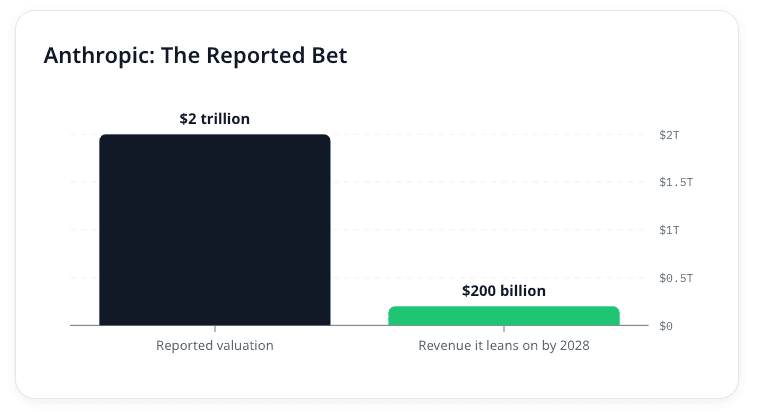
Anthropic, the leading AI company, is reportedly working toward going public at a two trillion dollar valuation.
Two trillion. Apparently they saw SpaceX’s $1.7 trillion valuation and decided to raise. That would make it one of the most valuable companies in America on the day it opens.
Reporters who saw the numbers say that valuation leans on the company reaching somewhere between a hundred ninety and two hundred billion dollars in revenue by 2028.
I want you to sit with that number for a second, because most people simply hear a big number and move on.
Two hundred billion dollars in revenue would put that company among the twenty largest businesses in the US. Bigger than almost anything you can name off the top of your head.
In about two years.
That's the bet. Not that AI even works. The bet is that one company gets that big, that fast, and then keeps it.
And I want to be careful here, because the obvious answer is wrong.
The banks are frothing at the mouth to take these AI companies public. They are not selling shares they could be keeping for themselves because they think artificial intelligence is a hoax. They know it isn't.
AI is going to change how this country works, and so is whatever comes after it.
They're selling because they already know how this part ends.
They've watched it before. Most of the men running these banks were sitting in the same building at a trading desk in 1999. One of the people on those desks was a man named David Trainer.
He worked at Credit Suisse through the dot com bubble. He watched the whole thing happen already, up close, with his own money and everybody else's.
Here's what he saw.
The internet was real. Nobody argues about that. It rewired the entire economy and made this country richer than anything since electricity.
Society won enormously for it. Trillions of dollars of value, spread across everybody.
Now the harder question. This is the one that separates what Wall Street knows from what you were told.
Which company kept the money?
Pets.com went public in February of 2000 and shut the doors that November.
Webvan burned through more than a billion dollars and was gone inside of three years.
And those are just 2 easy examples.
Here's the one that most people I talk to don't even realize.
Cisco Systems started in 1984 and is practically a household name.
I mean, they should be. Cisco built the actual plumbing of the internet. They've generated nearly half a trillion dollars in revenue over the last decade. If you understood in 1999 that the internet was going to change everything, Cisco was the correct answer.
Even so, Cisco stock peaked in March of 2000, and it took roughly twenty four years to get back to that price.
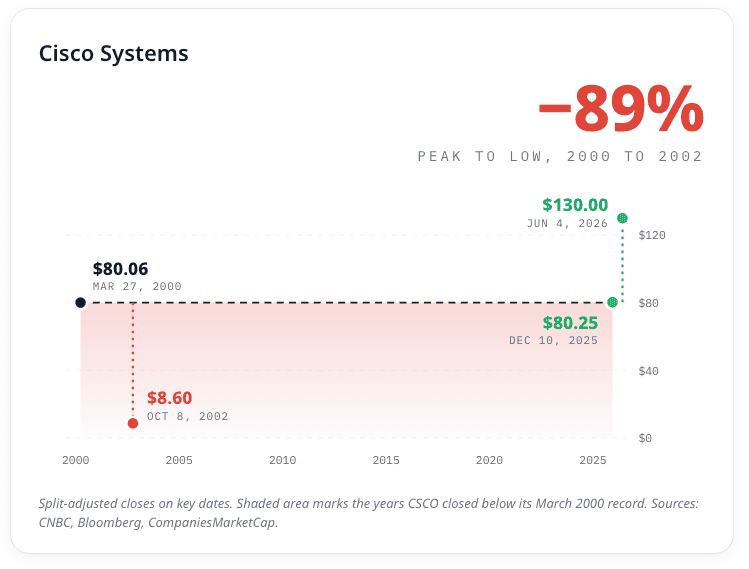
Twenty four years, for a company that was right about everything.
That's the lesson the people selling right now learned the hard way. Being right about the technology and being right about the stock are two completely different bets. And when a whole country agrees about revolutionary technology that’s never been seen before, the price stops having anything to do with what the business is worth because nobody really knows.
Which brings me to the part that makes me furious.
When Wall Street sells, somebody has to buy.
That somebody is you. Not because you got to decide for yourself.
When a company gets taken public and crosses a certain size, index funds are required to own it. Your 401(k) owns that index fund.
It doesn't matter what the company earns. Lately, it doesn't matter if it makes a profit at all.
You don't get a vote. Somebody who decided they're smarter than you is telling you what's in your best interest, and they have no clue themselves.
So right now, in your account, there are positions the smartest money in America was in a hurry to get rid of.
Some of them may become fair businesses at fair prices.
Some of them are Cisco in March of 2000, and you have no way of telling which is which.
Before this is over, I'm going to show you how to tell the difference in about thirty seconds. Without having to guess. Using a simple number, from filings these companies already have to publish.
I want to give you the scale of what happened last time, because I think most people remember the dot com bubble as a story instead of a number.
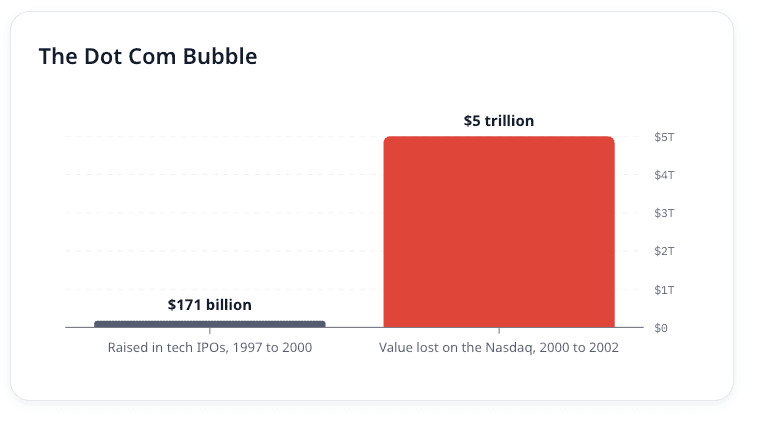
Between 1997 and 2000, Wall Street took 898 technology companies public. Those deals pulled a hundred seventy one billion dollars out of the public and into those companies.
In 1999 by itself, around 280 tech companies went public.
Then the market turned.
From March of 2000 to October 2002, about five trillion dollars of value came off the Nasdaq.
Five trillion. That was investment and retirement accounts absolutely wiped out. Taken from people who did nothing wrong except believe a story that happened to be true.
Now here's the number that tells you what was really going on.
Between September of 1999 and July of 2000, right as the market was topping, insiders at those dot com companies sold forty three billion dollars of their own stock.
Double the rate they'd been selling in prior years.
The people running the companies were getting out while the rest of the country was getting in.
Nobody sounded the alarm, there was no announcement. The filings showed it but once again, Wall Street was asleep at the wheel.
That's the part that bothers me most. It wasn't hidden. It just wasn't read.
We've been reading them ever since.
David Trainer started his career on Wall Street. Credit Suisse, during the dot com years. He watched analysts inside his own building put Buy ratings on companies that the bankers two floors up had just taken public.
Nobody thought of it as lying. That's what makes it work. When everybody is bullish on everything, nobody has to be dishonest about anything in particular.
So he left and started a research firm called New Constructs. That was over two decades ago. The firm doesn’t do banking. It doesn’t manage money for anyone. It sells research and that's it, which means there's nobody David has to please by getting the answer wrong.
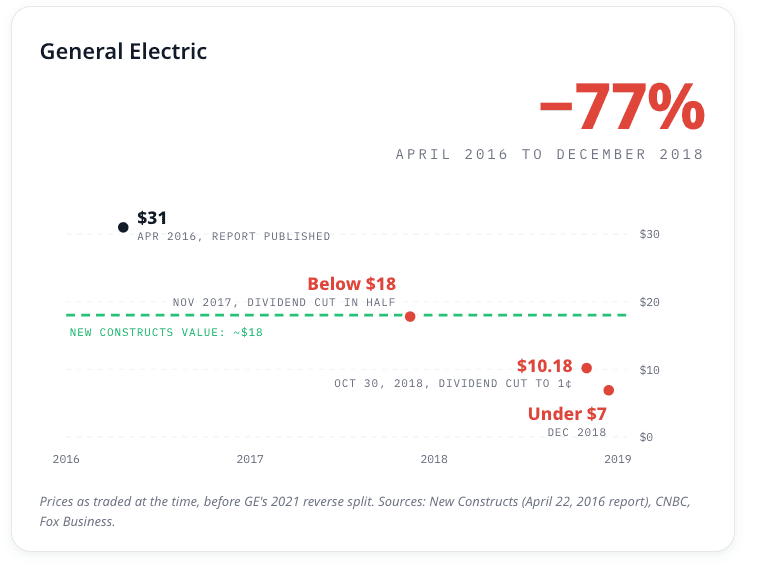
In 2016 New Constructs published a report on General Electric. Wall Street had Buy ratings on it. Money was pouring in.
The report said the stock was worth about eighteen dollars.
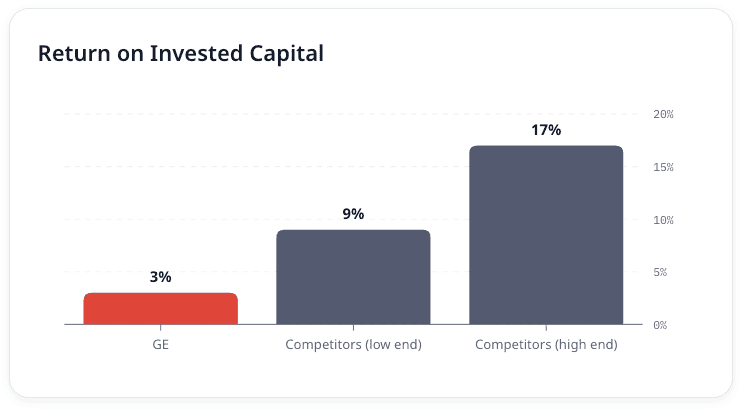
The reason was in the filings. GE's return on invested capital had fallen to about three percent while its competitors earned nine to seventeen. Reported earnings looked fine while real earnings didn't.
Wall Street ignored it, asleep at the wheel again.
By late 2018, GE traded under seven dollars. The dividend got cut and retirement accounts got gutted.
Two other things worth knowing, and then we'll get to how this actually works.
There's a site called SumZero where professional investors post their research and get scored against each other. Sixteen thousand of them. David Trainer has held the number one spot for sixty three months in a row.
And his methodology has been reviewed in research out of Harvard Business School and MIT Sloan.
So why now.
Here's the piece almost nobody outside the industry is watching.
Private equity is seizing up.
These firms buy companies, hold them a few years, sell them, and hand the money back to their investors. Those investors are pension funds and university endowments and state retirement systems. Maybe yours.
That last step, the handing money back, has slowed to a crawl. They're sitting on companies they can't sell for anywhere close to what they paid.
So they started doing something interesting. Instead of selling, some borrow against the companies to pay their investors. Others sell a company to a new fund they also happen to run.
That's kinda like selling your house to yourself and calling it a profit.
Private equity and Wall Street run on the same fuel. Cheap money, and a buyer waiting at the other end. Private equity stops singing first. It's the canary in the coal mine.
Which leads to the uncomfortable exercise.
Name one asset class right now that looks cheap?
Stocks are priced for a future that has to go perfectly. Real estate never came back down. Gold sits near records. Bonds got repriced and people are still absorbing it.
So tell me, what asset class looks cheap?
There isn't one.
That's what makes this different from the corrections you've already lived through. Usually money runs from one place to another. Stocks fall and bonds catch it. Something catches it.
When everything is expensive at the same time, there's nowhere for the money to run. This truly is Wall Street’s Final Cashout.
And the government can print itself out of this one the way it did in 2008 or 2020. The gap is bigger and the tools they could use are mostly spent.
So the people who can sell are selling. That's the whole story. It isn't a conspiracy and it isn't a crash prediction. It's a bunch of people who've seen this movie deciding they'd rather hold cash than hold the companies. And why should they? It’s only every American’s retirement account on the line after all.
Now we owe you thirty seconds.
Here's what almost nobody reveals to regular investors. A stock price is not an opinion. It's a math problem with the answer already filled in. It’s based on future value.
When you buy a stock, the price is telling you what has to happen for that price to make sense.
Most people look at stock price completely wrong. They guess what the company might be worth, then decide if the stock is cheap today. We run it backwards. We take the price the market is charging you today and solve for what the business would have to do to earn it.
Take Cisco in March of 2000 again.
At the price it hit that month, the math said Cisco had to grow profits at a high rate for decades before a buyer got their money back.
Well, Cisco grew. It generated over half a trillion dollars in revenue over the last ten years alone.
But it still wasn't enough. The stock price had already reflected every ounce of value in the company for 24 years.
That's how a company can be right about everything and still destroy a retirement account for 24 years.
There are two other numbers David and his team at New Constructs pull, and both live in the footnotes.
The first is what a company actually earned. Not the reported number. Companies are allowed to bury one-time items and write-offs and stock-based pay in places most people never look. New Constructs digs them out. Sometimes the real number is close. Sometimes it isn't close at all.
The second is whether the company earns more than it costs to fund it. That's the GE number. Three percent, when the money it takes to run the business costs more than that. A company like that burns value even while it reports a profit.
Put those together and you get one question you can ask about anything you own.
Is this business making real money, and does the price already assume something that has never happened to a company this size?
David's team built a machine that answers that. It reads every 10-K and every footnote across more than ten thousand securities.
You type in a ticker. You get an answer. Thirty seconds.
I should tell you who this was built for.
Not you. Not originally.
Hedge funds. Pension managers. Institutions with analysts on staff whose whole job is checking what the sell side hands them.
Those clients pay New Constructs on institutional terms for about twelve thousand dollars a month.
That isn't a brag. It's so you understand what the data is and where it came from. It's the same data and machine behind everything New Constructs does.
And for twenty years, the people paying twelve thousand a month were the only ones who got to see it. Which is a little funny, because they're the ones who need it least. They already have analysts.
The person who needs this is the one with eleven positions and a 401(k) and no way to check any of it.
So they built that version.
It's called New Constructs Research Premium.
Here's everything that's in it.
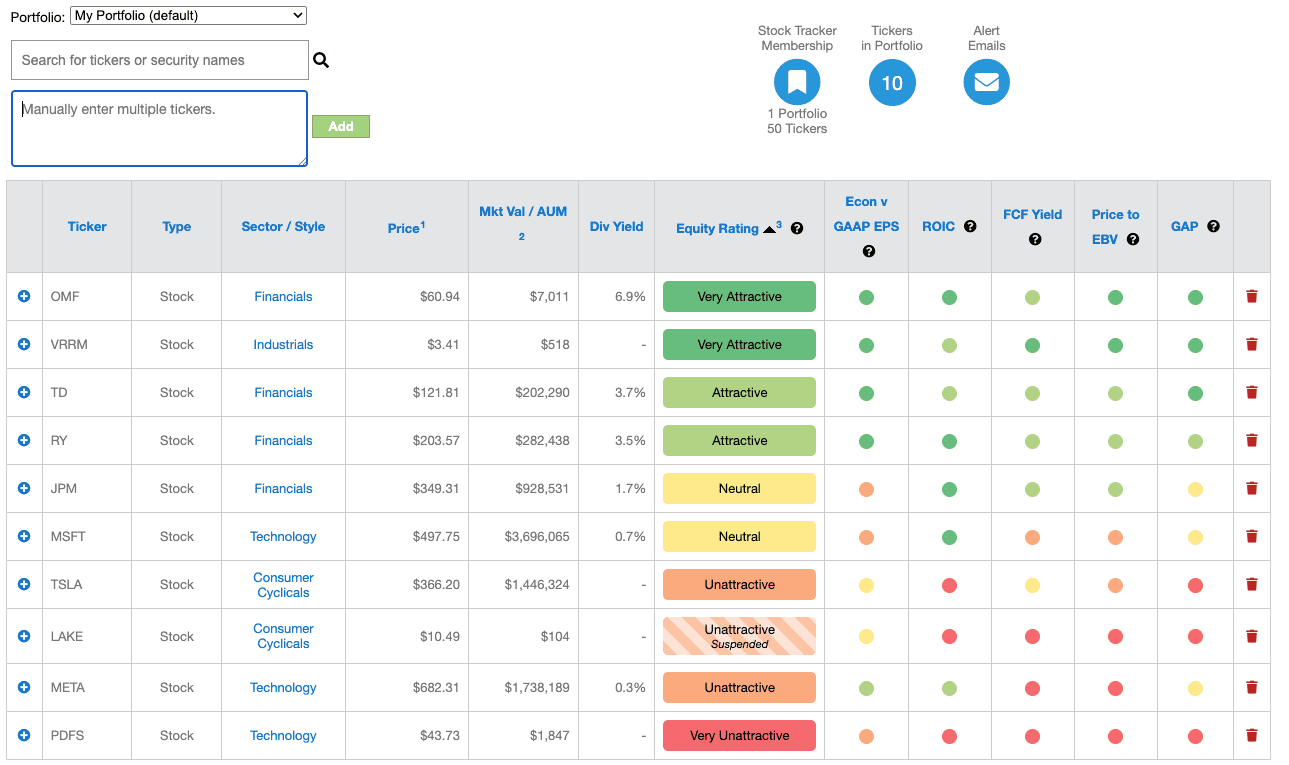
Stock Tracker. Type in a ticker, get a rating. Green, yellow, or red. It covers more than 10,000 securities, and every rating is built from the actual filings, not from anybody's opinion.
You can run your whole account through it in ten minutes. Most people do that the first night.
The Core Earnings Masterclass. Over 100 videos and articles from David's 25 years around Wall Street. These are the same lectures he gives at Harvard, Northwestern, and Vanderbilt.
You'll master ROIC, Economic Book Value, Free Cash Flow... the metrics that matter more than manipulated GAAP earnings.
This is the exact methodology that made me him the #1 stock picker on SumZero for 63 consecutive months.
Updated ratings all year. Companies file new financials every quarter. When the numbers change, or a rating changes, you'll know. You're not buying a snapshot of today's market that is going to be outdated next month. You're buying a year of us watching and giving you the best data possible.
Then there are three reports we're including because of the specific moment we're in.
Report one. The Final Cashout List. These are the companies carrying the most risk into what we've described today. Household names, most of them. Names that are in your index fund whether you chose them or not.
Report two. 7 Stocks to Avoid. This is the Cisco problem applied to today. The technologies that are genuinely going to change this country, and the companies whose prices already assume they win all of it.
Report three. The Long Shot. Any portfolio should have asymmetric bets. A company with huge upside potential. This company could just as easily go to zero as it is to be a homerun but the risk/reward profile here is very appealing.
For twenty years this cost institutions five figures a month.
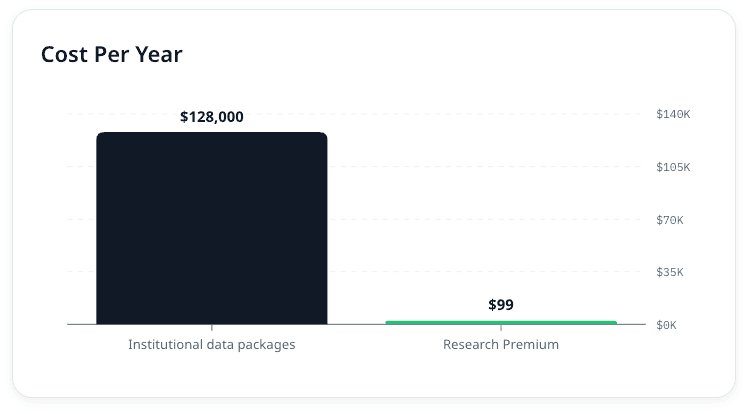
Membership is ninety nine dollars for the full year.
Not a trial that bills you later at some other number. Ninety nine dollars, twelve months.
It’s $99 for one year and you get everything I just listed.
And if you use it for 30 days and decide it wasn't worth it, write to us and we'll refund every dollar. You keep the reports.
David can offer that because he knows what happens when people check their own portfolio. Almost nobody checks one stock and stops.
Here's where we'll leave it.
In every one of these cycles there are two groups. There's the group that sells, and there's the group that gets sold to.
Nobody in the second group ever signed up for it. That's what we want you to understand. They didn't make a bad decision. They were the other side of somebody else's good one.
Right now you're in that second group by default. Not because you chose it. Because an index fund bought something on your behalf and nobody asked you.
You get out of that group by checking.
That's it. That's the whole flip. The people who came through 2000 fine weren't smarter than everyone else. They just looked at what they owned before it mattered instead of after.
Click below. Ninety nine dollars for the year.
Then type in the one stock you feel best about, because that's usually where the surprise is.
One more thing, and then we'll get out of your way.
The reason we're in a hurry about this isn't the price. The price will probably still be ninety nine dollars next month.
It's the calendar.
There are more of these deals lined up behind Anthropic. Every one that prices and crosses that size threshold gets bought by the index funds automatically. Which means it gets bought by you automatically.
You can check your account before that happens or after. The information is the same either way. What changes is whether you still have the option to do anything about it.
I'd rather you look now.
The GE Warning That Cost Investors Big
In 2016, Wall Street rated General Electric a Buy at $31/share while its return on invested capital had collapsed to 3%. We believed it was worth at best $18/share. Two years later, GE traded under $7 and the dividend got cut.
The same red flags are sitting in filings right now — for stocks you probably already own. 10,000+ ratings, updated all year, for $99.
Skip Ahead — Get Research Premium for $99 No thanks, take me back to the articleIMPORTANT DISCLAIMER: Stock Tracker and Core Earnings data are provided for informational and educational purposes only and should not be considered investment advice. Past performance, including the Core Earnings Leaders Index outperformance of the S&P 500, does not guarantee future results. All investments carry risk and you may lose money. Consult a qualified financial advisor before making investment decisions.
© 2026 New Constructs, LLC. All rights reserved. | Disclosures & Disclaimers | Privacy Policy | Terms of Use