
Wall Street is about to steal even more from main street investors than they did in 2008.
In fact, they already started.

The banks made record fees taking companies public in the first quarter of this year.
Most people hear that and figure business must be booming.
They’d be wrong…
Because banks don't get paid when stocks go up. They get paid when stocks change hands. So a record quarter doesn't tell you the market is healthy. What it tells you is that a lot of people decided to stop owning things.
An IPO gets sold to you as a celebration. The Confetti and the bell ringing while the founder is all smiles.
Strip the celebration away and here's the truth.
People who already own a company decided they'd rather own cash. So they sold you a piece of it and a bank took a cut for arranging the handoff.
Think about it… the sellers have seen every contract and every problem going back years. They know what that company is worth better than anyone alive.
Yet, they decided the cash was worth more.
So the only question that matters is why.
And I want to be careful here, because the obvious answer is wrong.
The banks are frothing at the mouth to take these AI companies public. They are not selling the shares they could be keeping for themselves because they think artificial intelligence is a hoax. They know it isn't.
AI is going to change how this country works, and so is whatever comes after it.
They're selling because they already know how this part ends.
They've watched it before. Most of the men running these banks were sitting on a desk in 1999, I would know - I was at Credit Suisse during the dot com bubble myself. They saw the whole thing happen once, up close, with their own money.
Here's what they saw.
The internet was real. Nobody argues about that. It rewired the entire economy and made this country richer than anything since electricity.
And society won enormously for it.
Not to mention the trillions of dollars that has been generated because of the invention of the internet.
Now the harder question, and this is the one that separates what Wall Street knows from what you were told.
Which company kept the money?
Pets.com went public in February of 2000 and shut the doors that November.
Webvan burned through more than a billion dollars and was gone inside of two years.
And those are the easy ones.
Here's the one that most people I talk to don’t even realize.
Cisco Systems started in 1984 and is practically a household name.
They should be, Cisco built the actual plumbing of the internet. They’ve generated nearly half a trillion dollars in revenue over the last decade. If you understood in 1999 that the internet was going to change everything, Cisco was the correct answer.
Even so, Cisco’s stock peaked in March of 2000 and it took roughly twenty four years to get back to that price.
Twenty four years for a company that was right about everything.
That's the lesson the most important people on Wall Street learned the hard way. Being right about the technology and being right about the stock are two completely different bets. And when a whole country agrees on the story, the price stops having anything to do with what the business is worth.
Which brings me to the part that makes me furious.
When they sell, somebody has to buy.
That somebody is you. Not because you got to decide for yourself. You see, when a company gets taken public and crosses a certain size, index funds are required to own it. Your 401(k) owns that index fund.
It doesn't matter what the company earns. In fact it doesn't matter if it makes a profit at all.
You don’t get a vote, somebody that’s decided they’re smarter than you decided it’s what's in your best interest.
So right now, in your account, there are positions the smartest money in America was in a hurry to get rid of.
Some of them may become fair businesses at fair prices.
Some of them are Cisco in March of 2000, and you have no way of telling which is which.
Before this is over, I want to show you how to tell the difference in about thirty seconds.
But first, I want to describe a specific feeling to you, and you tell me if you know it.
It usually happens on a Tuesday. Nothing special about the day. You pull up your account because you always pull up your account, and one position is down thirty percent.
Not the whole market. The market's fine. Just your position.
And you go looking for the reason, because there's always a reason. You read the news and the earnings release. You read the analyst’s commentary.
Everything looks the same as it did last month. It’s the same story with the same guidance and the buy rating hasn’t changed.
So you sit there with a stock that dropped thirty percent and an explanation that explains nothing.
That's the feeling. Not the loss. Most of us here can handle a loss.
It's not knowing why.
Because if you knew why, you'd know what to do next. You'd know if it's a sale or a mistake. But you don't know, so you do the thing everybody does.
You wait.
You tell yourself you're long term. You tell yourself the story is still intact, and honestly, it usually is. The company is still going to be a big deal. The industry is still going to change the world.
And the stock just keeps sitting there.
It's kinda like waiting on a guy who owes you money. Every time you call, he picks up. He's friendly. Says the check's coming. Nothing about the conversation feels bad enough to do anything about it, so you hang up and wait some more.
A year of that goes by. Then two.
Here's what I want you to understand about that Tuesday.
You did not make a bad decision.
You read the same headlines everyone read. You bought a company in an industry that is genuinely going to reshape this country. If you'd asked ten smart people, nine of them would have told you it was a good idea, and they'd have been giving you their honest opinion.
The information you had was correct.
The information you didn't have is that the price already reflected all the potential. Every bit of growth, every year of it, priced in before you ever clicked buy.
Nobody tells you that part. There's no headline for it. The earnings release won't say it. The analyst won't say it, and I'll explain in a minute why they can't.
So you were making a decision with half the information and no idea half was missing.
That's not a knowledge problem. You know plenty.
This is a measurement problem.
And the reason it keeps happening to you is that the one number that would have warned you is not printed on any screen you've ever looked at.
It's in the filings.
My name is David Trainer.
I started my career at Credit Suisse. I was one of the people writing the research. I sat in those meetings. I know exactly how the sausage gets made because I stood at the machine.
I left in 2002.
Not because of some dramatic falling out. I left because I kept running into the same problem and nobody upstairs thought it was a problem.
Here it is.
Every company in America files a document with the SEC once a year. It's called a 10-K. It runs a couple hundred pages. Buried in the back, in the footnotes, is what the company actually earned.
The number on the front page is something else. It's legal. It's audited. It's also assembled to look as good as the rules allow.
Two numbers on the same company in the same year.
The one on the front page is the one CNBC talks about. The one in the footnotes is the one that tells you whether the company is actually profitable.
I thought somebody should read the footnotes.
Turns out reading them by hand takes a trained analyst most of a week for one company. There are more than 10,000 companies. Obviously, that math doesn't work.
So we built a machine to do it.
It took years and it cost more than I want to say out loud. It reads every filing, pulls the footnotes apart, and rebuilds the earnings from scratch. Hundreds of thousands of filings so far.
Harvard Business School and MIT Sloan both published a paper proving our footnotes data matters. Ernst and Young reviewed the methodology.
There's a site called SumZero where professional money managers post their research and get scored against each other. More than 16,000 of them.
I've been ranked number one for 63 straight months.
I'm not telling you that to impress you. I'm telling you because of what it means about everybody else.
If a guy in Tennessee reading footnotes can beat 16,000 professionals for five straight years, the professionals are not doing the work.
They're not lazy, in fact most of them are sharp people. They're just paid to produce something other than the truth.
And that brings me to the part I've never been able to say fully on television.
Let me show you why the man writing the research on a stock cannot tell you what he actually thinks about it.
Right now, 96 percent of the stocks Wall Street covers are rated Buy or Hold.
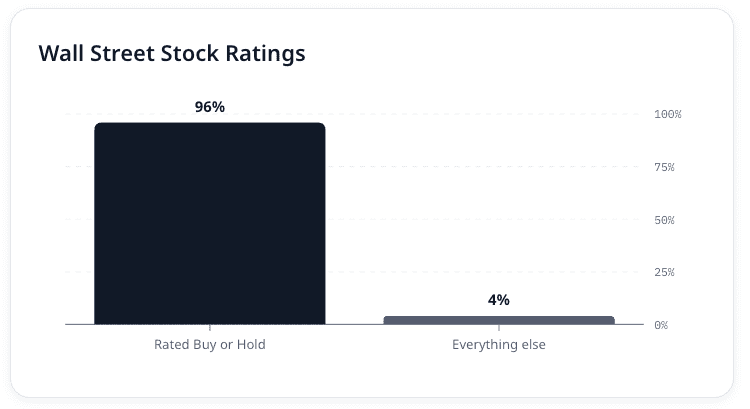
Ninety six out of a hundred.
Sit with that. If almost everything is a Buy, the rating isn't information. It's simply a rubber stamp.
And here's why it works that way.
The bank that takes a company public is very often the same bank whose analyst writes the research on it afterward. They work in the same building and sometimes the same floor.
That analyst is not going to publish a Sell on a company his own firm just sold to the public. It would cost the bank the next deal, and the next deal is where the money is.
What I’m revealing here isn’t some conspiracy either. Nobody's in a back room. They do this in public, in front of everyone and nobody cares… It's just the business model working exactly as designed.
So the man with the best information has the least freedom to use it.
It's kinda like asking a car salesman if now's a good time to buy a car. He's not lying to you when he says yes. He just doesn't have a version of himself that says no.
Now, remember the record quarter I opened with?
Those fees came from the machine I just went over. Take a company public, collect the fee, hand the stock to the public, rate it a Buy.
For years that game had a name inside the industry. Double or nothing. Take the risk, take the fee, and if a deal blows up there's another one next quarter.
Well folks… That game is over. There is nothing left.
Now it's double or double. Everything gets sold, it gets a story. Everything gets a Buy. It’s frankly ridiculous.
And I would not be standing here saying this out loud if it were only happening in the stock market.
Here’s the bombshell that made me go public with this…
You see, right now Private Equity is seizing up.
These are the firms that buy whole companies, hold them five or six years, sell them, and hand the money back. Their investors are pension funds. University endowments. State retirement systems. The places your neighbors' money lives.
The last step in the Private Equity playbook has slowed to a crawl. They're sitting on companies they bought years ago that nobody will pay their price for.
So they started doing something creative. Instead of selling, they borrow against the company to pay their investors. Or they sell a company to another fund they also happen to run. Funny how that works, don’t you think?
That's kinda like selling your house to yourself and calling it a profit.
Private equity and Wall Street run on the same two things. Cheap money and somebody at the other end willing to buy.
Private equity is the canary in the coal mine. It stops singing first. And for you listening at home - the music has stopped.
One more devastating piece of evidence and then I'll show you what to do about it.
I want you to name one asset class right now that looks cheap. Just one.
Because stocks are priced for a future that has to go perfectly. Real estate never fully came back down into something reasonable. Bonds got repriced and people are still absorbing it. Gold is near a record.
Think about it, I'll wait.
The fact is, there isn't one.
That's what makes this different from every correction you've sat through. Normally money runs from one place to another. Stocks fall and bonds catch it. Something catches it.
When everything is expensive at once, there's nowhere for the money to run.
And if the government keeps printing dollars to get out of this one the way they’ve done again and again, they make the problem worse by stoking inflation. The gap is too big to close with more stimulus because we’ve been stimulating everything for decades now.
So here's where that leaves you.
You cannot control any of what I just described. Not the banks, not the Fed, not private equity.
You can control one thing. You can find out which of the companies you own are actually worth their salt. With profits that can justify their stock price.
Let me show you how that's done.
There are two numbers that decide whether a stock makes you money. Almost nobody looks at either one.
Number one. What does this company actually earn.
Number two. What does the current stock price already assume it's going to earn.
Now, it sounds simple but it’s a bit more complicated than that so let me explain.
Let's take them one at a time.
The reported earnings number, the one in the headline on the news sites, includes things that have nothing to do with the business. A company sells a building and books the gain as profit. A legal settlement gets buried in fine print. Stock shares handed to executives gets treated like they’re free.
None of that tells you whether the business makes money. It tells you what the accountants were allowed to do.
We pull all of the accounting magic that these companies spend a fortune making back out. What's left is what we call Core Earnings. This is the real number, the north star of investing.
The gap between the number you see and Core Earnings is a pit of money that seemingly everyone but you gets a piece of, and frankly speaking… the gap is not small. We've seen companies report a profit while losing real money.
Now the second number, and this is the one that would have saved you on that random price drop I described earlier.
You see, every stock price is a prediction. When you buy at a certain price, you're agreeing to a set of assumptions about how much that company will earn over the coming years.
Most people never see those assumptions. They see the stock price and that price feels like a fact.
We run it backwards. We take the stock price and calculate what the company would have to earn to justify it.
Sometimes the answer is reasonable. Grow a little, keep your margins, that’s fine.
Sometimes the answer is that this company would need to earn more than any company its size has ever earned in the history of American business. Sounds easy enough, right?
That second one is a stock that can be a wonderful company but a terrible investment at the same time.
That's Cisco in March of 2000. Cisco is the backbone of the internet, they’re still around and have generated over half a trillion dollars in revenue in the last several years. They were right about everything. But look at this stock chart.
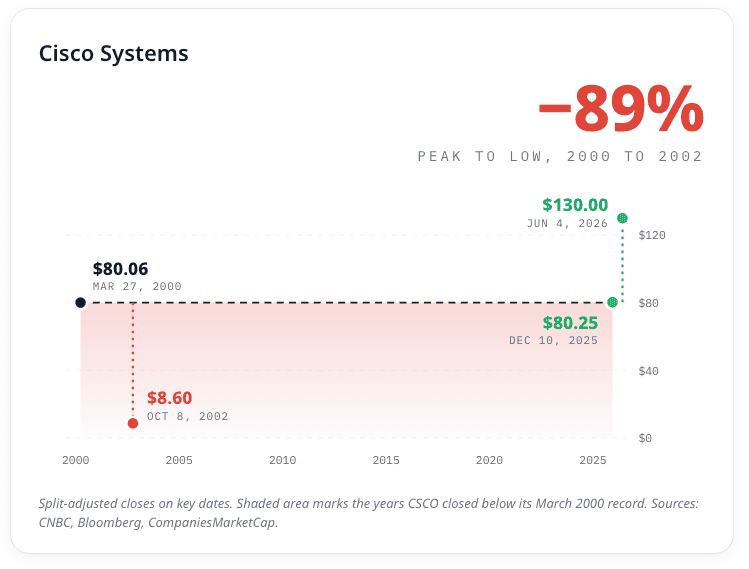
Cisco all the way back in 2000 was priced for something that took 24 years to come true.
Let me show you what this looks like in real life.
In 2016 we published a report on General Electric.
Wall Street had Buy ratings on it and the money was pouring in. It was in every retirement account in America because it was in every index.
We said the stock was worth about 18 dollars.
The reason, as always, was sitting in the filings. GE's return on invested capital had fallen to about 3 percent. Meanwhile, its competitors were earning 9 to 17.
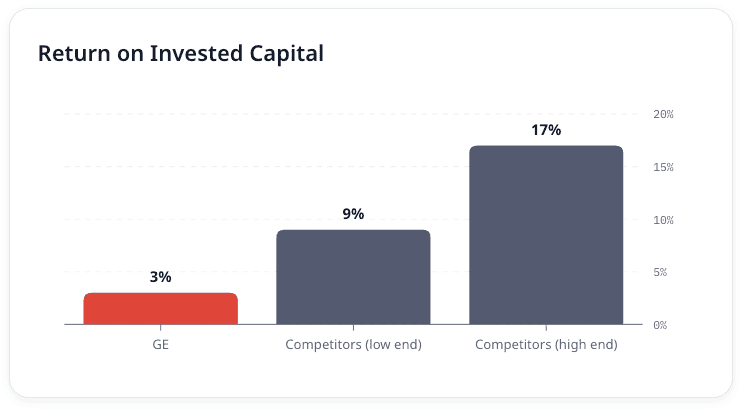
Once again, the reported earnings looked fine but the real earnings didn't.
We published our report and Wall Street ignored it.
By late 2018 GE traded under 7 dollars. The dividend got cut and the people who'd bet on GE based on the reported earnings watched their retirement get cut in half.
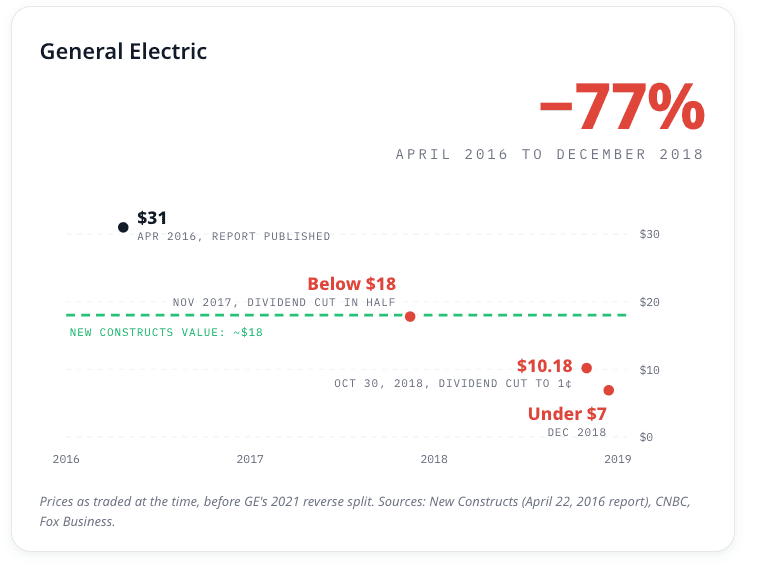
Nothing about that was a surprise if you read the footnotes. It was a surprise to everyone who read the headline.
Now here's what I want you to see, because this is the part that changes what you can do on your own.
We turned all of that into one screen.
You type in a ticker. Any ticker.
You get a color.
Green means the numbers work. The company earns real money and the price doesn’t require a miracle.
Yellow means the reported earnings and the real earnings are telling different stories, and you should know that before you buy more.
Red means the price already assumes any reasonable measure of profit growth and then some.
We won’t give you a long 200-page report full of Wall Street Jargon or some inconclusive decision. It’s simple, easy-to-use and designed for any investor.

Thirty seconds.
That's what it takes to answer the question you couldn't answer on that Tuesday.
And I want to be clear about something, because this is where people get the wrong idea.
A red rating does not mean the company is going out of business. GE didn't go out of business. GE is still there.
It means you are paying a price that requires everything to go right, and you're not being paid to take that chance.
That's the whole game. Not picking winners. Not timing anything.
Knowing what you actually own before somebody needs to sell it to you.
I want to read you a couple of notes from members, because I think they'll sound familiar.
This one's from Joe P.
"Simply and instantly, you can see how your stocks or funds are rated and where they are trading compared to economic book value. For someone with limited time to spend ‘watching’ the stock market, this top-down view is incredibly useful."
Joe P.
That's the whole story. He didn't find a rocket ship. He found out which of his own holdings was the problem, and he'd been sitting on it without knowing.
Here's another from John.
"I took $105M of my funds and invested with a prominent investment firm (big trust company). Within 10 months they lost $11M (on 1,100 stock trades and investing in long-term bonds at low rates)…this did not fit my guidance of protecting my principle and maintaining a low risk. My belief was let the big boys manage it and take some time off after a 45-year career. MISTAKE! Incompetence can be wrapped in a very pretty package. I took over the account on January 14, 2023.
Since that time (and with your tool), I have made my money back with reduced risk. I sold off their bad stuff, kept the good stuff and bought new stuff.
The stocks I sold off had a 5.12% return (had I held them), the stocks I kept had an 18.08% return and the stocks I purchased (see below) had a 10.32% return (annualized 20.4% return)."
John
I want to point at that one for a second.
Everybody assumes a tool like this is for finding what to buy. Half of what it does is tell you to leave something alone.
Do you know how much money gets lost by those of us who sell a good company at the bottom because they had no way to tell the difference between a bad business and a bad stock price?
Most of it… That's where most of it goes.
One more.
"It's simply too time consuming and confusing to go through and understand filing documents to pick good companies to invest in. Almost impossible given the amount of information. New Constructs' summaries and research articles are factual, meaningful and easy to understand."
That one stuck with me.
Because the thing we lose isn't only money. It's the hours. It's the Sunday afternoons. It's the part of retirement you were supposed to get back.
You didn't work for forty years so you could take a second job staring at charts and hoping.
I want to stop and talk to one specific person watching this.
If you’re somewhere in your later years you’ve probably been in the market a long time. You've been through 2000, you've been through 2008, and you've been through whatever they’re going to call the last few years.
And a voice in the back of your head has been saying the same thing for the last ten minutes.
It's too late for me.
Too late to learn something new. Too late for it to matter. The big money got made by people who started at thirty and you're not thirty anymore.
Let me say the real thing clearly here.
At 50, 60 or 70, you are not trying to become part of the 1%. You already know what you have and it wouldn’t hurt to have a little bit more. What you're trying to do is not lose it in the last stretch, because there is no next paycheck to fix it with anymore.
That's the entire goal.
And here's the thing about being late that you probably won’t hear from anyone else.
Being late is exactly why this matters more for you than it does for a thirty year old. A thirty year old can be wrong about a stock for ten years and still retire fine. Time bails him out.
You don't have that. So the price of not knowing what you own is higher for you than it is for anybody else in this market.
Too late is the wrong way to think about it.
I want to tell you who's been using this data up until now.
Hedge funds, some pension consultants and a few family offices. The kind of places where a bad quarter can cost somebody their job.
They pay us because the cost of not knowing is too great a risk, and the number is in the tens of thousands of dollars. Some of the bigger institutional data packages in our business run over $128,000 a year.
And they're not paying that because we're charming. They're paying it because the alternative is trusting the same 96 percent Buy ratings you've been trusting, and they can't afford to.
Now think about what that means.
The information that tells you whether a company actually makes money has been priced so only institutions could have it.
And it isn’t because there's some law that restricts your access to the information. But because it costs a fortune to produce, and the only people who could pay for it were the people already sitting on other people's money.
So here's the situation you've been in your whole investing life.
You're competing for the same shares as somebody who knows what the company actually earns, and you're working off the press release.
It's kinda like sitting down at a card game where the other guy can see one of your cards. He doesn't have to be smarter than you. He doesn't have to cheat. He just knows one thing you don't, and over enough hands, that's everything.
That's been the arrangement for decades now.
I've been trying to break that arrangement for twenty four years, and for most of that time I couldn't, because the cost of producing the research made it impossible to produce for an average person at a cost that wasn’t the size of their portfolio.
Something changed a couple years ago.
Finally, the machine got fast enough that we can run the whole market without adding more people and creating a massive operation. We had the knowledge and data already, but our ability to process millions of pages a year was the biggest bottleneck.
Which means for the first time since I started this company, I can put the same data in your hands that I put in theirs.
And I can do it for a number so low that's going to sound like a mistake.
It's called New Constructs Research Premium.
Here's everything that's in it.
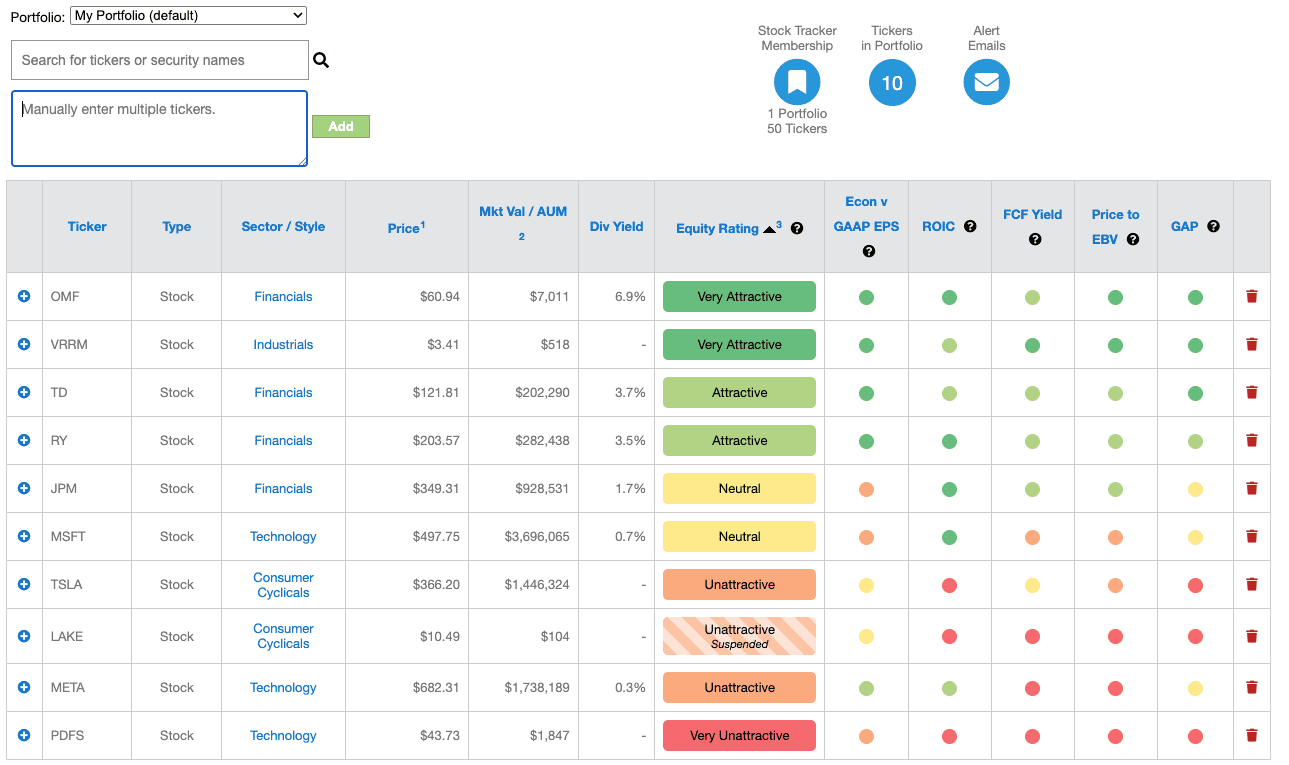
Stock Tracker. This is the screen I showed you. Type in a ticker, get a rating. Green, yellow, or red. It covers more than 10,000 securities, and every rating is built from the actual filings, not from anybody's opinion.
You can run your whole account through it in ten minutes. Most people do that the first night.
The Core Earnings Masterclass. Over 100 videos and articles from my 25 years on Wall Street. These are the same lectures I give at Harvard, Northwestern, and Vanderbilt.
You'll master ROIC, Economic Book Value, Free Cash Flow... the metrics that matter more than manipulated GAAP earnings.
This is the exact methodology that made me the #1 stock picker on SumZero for 63 consecutive months.
Updated ratings all year. Companies file new financials every quarter. When the numbers change, or a rating changes, you'll know. You're not buying a snapshot of today's market that is going to be outdated next month. You're buying a year of us watching and giving you the best data possible.
Then there are three reports I'm including because of the specific moment we're in.
Report one. The Final Cashout List. These are the companies carrying the most risk into what I've described today. Household names, most of them. Names that are in your index fund whether you chose them or not.
Report two. 7 Stocks to Avoid. This is the Cisco problem applied to today. The technologies that are genuinely going to change this country, and the companies whose prices already assume they win all of it. This is the report I'd want if I were you.
Report three. The Long Shot. Any portfolio should have asymmetric bets. A company with huge upside potential. This company could just as easily go to zero as it is to be a homerun but the risk/reward profile here is very appealing.
Now as I already said, institutions pay us tens of thousands a year for this data.
I'm not going to ask you for anything close to that. I'm not going to ask you for a thousand dollars.
Or $500.
Or $200.
One year of Research Premium is $99.
$99 a year for our best research updated in real time.
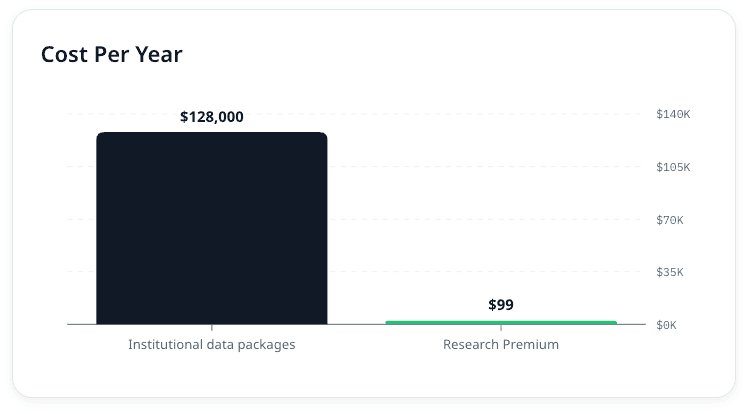
That's about 27 cents a day. It's less than most people spend on lunch in a week.
And I want to say why it's that number, because if you're the kind of person who gets suspicious when something is cheap, good. Stay suspicious. That instinct is why you still have money.
Here's the honest answer.
The research already exists. We built it for the institutions and they already paid for it. Handing you a login costs me almost nothing.
And I got out of Wall Street to stop handing wealthy people paydays and start handing real Americans a real chance at retiring.
So this isn't a discount and it isn't a trial that bills you later at some price I didn't mention. There's no phone call with a special bonus offer.
It’s $99 for one year and you get everything I just listed.
- Stock Tracker.
- The Core Earnings Masterclass.
- Updated ratings all year.
- The Final Cashout List.
- 7 Stocks to Avoid.
- The Long Shot.
And if you use it for 30 days and decide it wasn't worth it, write to us and we'll refund every dollar. You keep the reports.
Let me tell you what actually separates the people who do well heading into retirement from the people who don't.
It isn't intelligence. I've watched brilliant people lose half of what they had.
It isn't how much you start with. It isn't timing, and it isn't nerve.
It's which number you're reading.
There are two kinds of investors in this country right now.
One reads the headline. He hears the story, he sees the price go up, he assumes somebody responsible checked the math. He's trusting a system he was told he could trust.
The other relies on the real numbers, the ones in the footnotes. With a simple run of our Stock Tracker he knows if his stocks are truly attractive or not. He knows what his companies actually earn, and he knows what he's paying for them.
For most of your investing life you've been the first guy. Not because you chose it. Because the second option cost a hundred thousand dollars a year and lived on a Bloomberg terminal in Manhattan.
That's over as of today.
For $99, you become the second guy.
And here's what happens the first night, because it happens to almost everybody.
You run your account. Most of it comes back green, and you feel something you probably haven't felt in a couple of years, which is relief.
Then one comes back red. And it's usually the one you were most confident about, because the ones you're most confident about are the ones you bought when everybody agreed.
That's the moment. It’s not some massive windfall. Think about how certain you’ll be compared to everyone around you for the first time in a long time that you actually knew something about which stocks to buy and which stocks to sell.
The button's right below.
$99 for one year. You get instant access to Stock Tracker, the The Core Earnings Masterclass, the ratings all year, and the three reports.
Including our Ironclad 30-day Money Back Guarantee that let’s you run your portfolio through Stock Tracker, read the reports, check the The Core Earnings Masterclass and so much more for the next 30 days AND still give you your money back if you’re unsatisfied in any way.
Wall Street has spent this year moving what they own into cash and handing the rest to people who never got a vote.
Somebody is on the other side of that trade.
You get to decide today which side you're on.
Click the button. Type in one ticker.
You'll know in thirty seconds whether you're the one cashing out, or the one losing cash.
I only want to leave you with one thought.
The cost of being wrong about this is $99 and half an hour of your evening.
The cost of being right about it, and doing nothing, is a number I can't calculate for you because only you know what's in the account.
I'd guess you already know there’s something hiding in your portfolio that could be dangerous. There's one you've been not-looking-at for a while now, and the not-looking has become its own kind of decision.
That's really all I'm asking. Look at it.
If it comes back green, you paid $99 to stop carrying some amount of stress around. That's a bargain at three times the price.
If it comes back red, you found out on your terms, with time to think about it, instead of finding out the way most people find out.
Which is at 9:30 in the morning, after it’s already taken down your portfolio, after it's already done.
The button's below.
FAQ
Let me get in front of what you're thinking. I've been doing this long enough to know what it is.
"I've bought something like this before and it didn't work."
Probably true. Most of what gets sold to people in your position is somebody's opinion with a subscription attached. You pay for a guess.
This isn't a guess. It's arithmetic on numbers in documents the company was legally required to file. The filings are public. That's the whole point.
If I'm wrong about a company, you can find where I'm wrong. Try that with a newsletter.
"I don't have time to learn a new system."
There's nothing to learn. You type four letters and a color comes up.
I say that and people don't believe it, so let me be blunt. If you can look up a weather forecast on your phone, you already have every skill this requires.
"I'm too old for this."
I talked about Joe earlier so I won't repeat it. I'll just say the shorter version. The less time you have to recover from a mistake, the more it's worth knowing about the mistake in advance.
"Ninety nine dollars for something institutions pay thousands for. What's the catch."
I told you the catch. I want you as a member for the next twenty years, and the cheapest way to get you is to give you something that works.
If that answer doesn't satisfy you, use the 30 day guarantee. Run your whole account through it in the first week. If it doesn't show you something you didn't know, ask for your money back and keep the reports. I'd rather lose 99 dollars than have you sitting there suspicious.
"What if the market keeps going up?"
Then a lot of your holdings come back green, you sleep better, and you spent 99 dollars finding that out.
I'm not asking you to bet on a crash. I've never made money predicting the day something happens and neither has anybody else, whatever they tell you.
I'm asking you to know what you own. That's worth doing in a good market and a bad one. It's just worth more in this one.
"Are you telling me to sell everything?"
No. And if anybody tells you that, close the browser.
Most of what you own is probably fine. In my experience it's usually one or two positions carrying most of the danger, and it's almost never the one you'd guess.
That's the actual value here. Not a sign to run. A way to find the one thing in your account that doesn't belong there.
Last one, and this is the one most people I know think, but won’t say out loud.
"What if I look and I don't like what I see."
I understand that. Not looking feels safer.
It isn't. The position doesn't get better while you're not looking at it. It just gets more expensive to fix.
You already know which holding you'd be nervous to check. Everybody does.
Start with that one.
The GE Warning That Cost Investors Big
In 2016, Wall Street rated General Electric a Buy at $31/share while its return on invested capital had collapsed to 3%. We believed it was worth at best $18/share. Two years later, GE traded under $7 and the dividend got cut.
The same red flags are sitting in filings right now — for stocks you probably already own. 10,000+ ratings, updated all year, for $99.
Skip Ahead — Get Research Premium for $99 No thanks, take me back to the articleIMPORTANT DISCLAIMER: Stock Tracker and Core Earnings data are provided for informational and educational purposes only and should not be considered investment advice. Past performance, including the Core Earnings Leaders Index outperformance of the S&P 500, does not guarantee future results. All investments carry risk and you may lose money. Consult a qualified financial advisor before making investment decisions.
© 2026 New Constructs, LLC. All rights reserved. | Disclosures & Disclaimers | Privacy Policy | Terms of Use