

America cannot train healthcare workers fast enough, and the constraint is the classroom, not the hospital.
This week’s Long Idea is paid to build the workforce health systems cannot recruit alone.
A supply crunch is occurring at a time when demand for healthcare workers is rising, and that gap will only increase and drive profits for nursing educators over the next decade.
Meanwhile, the company’s valuation implies it will hardly improve its profits over the rest of its corporate life. This disconnect creates opportunity.
Below, we provide an excerpt from our latest Long Idea report. Get the full report a la carte here.
This stock presents quality Risk/Reward based on the company’s:
- industry leading scale,
- barriers to entry through regulations and accreditation requirements,
- guaranteed clients via partnerships with healthcare systems,
- expansion opportunities, including six campuses in active development,
- strong FCF generation that supports billions in share repurchases, and
- a cheap stock price that implies profits will barely grow in the future.
Workforce Shortages Create Long-Term Demand
Healthcare workforce shortages are likely to worsen across the next decade.
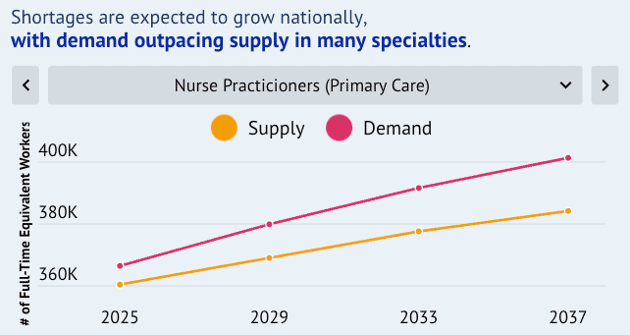
According to The National Institute for Health Care Management (NIHCM), 47 states will have a shortage of primary care physicians by 2037. The NIHCM projects the nurse practitioner shortage will widen from 5,950 in 2025 to 17,030 in 2035. This gap is projected to rise even as the Bureau of Labor Statistics estimates the number of registered nurses grows 6% between 2025 and 2035, and the number of advanced practice registered nurses (APRN) grows 36% over the same time.
Overall, critical shortages of family medicine physicians, OB-GYNs, pediatrics, geriatrics, pharmacists, and nurse practitioners exist and are projected to grow.
Figure 1: Nurse Practitioner Shortage in the US: 2025-2037
Sources: NIHCM
Nursing School Enrollment Not Keeping Up With Demand
The American Association of Colleges of Nursing (AACN) puts it plainly: “nursing schools across the country are struggling to expand capacity to meet the rising demand for care”.
Enrollment in entry-level baccalaureate programs rose by 7.6% in 2025, while enrollment in PhD programs declined 3% year-over-year, which represents the eleventh consecutive YoY decline.
Within nursing schools, there is shortage of faculty, classroom space, clinical sites, and preceptors in an environment of tightened budgets. As a result, U.S. nursing schools turned away over 93,000 qualified applications from baccalaureate to graduate nursing programs in 2025. Of this 93,000, 17,000 qualified applications were turned away from graduate nursing programs, which limits the pool of potential nurse educators, and makes training future nurses even more difficult.
FCF Supports Capital Return
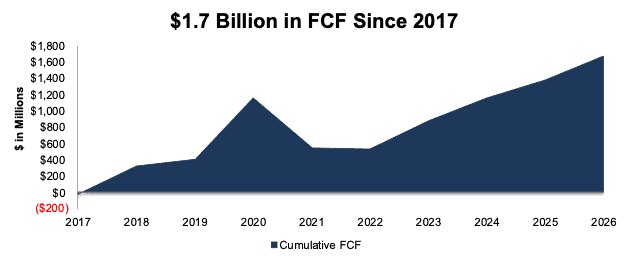
From fiscal 2017 through fiscal 2026, the company generated a cumulative $1.7 billion in free cash flow (FCF), which equals 33% of the company’s enterprise value. In 2026, the company generated $294 million in FCF.
Importantly, the company generates more than enough FCF to support its ongoing share repurchases. Since fiscal 2017, the company has repurchased $1.6 billion shares.
Figure 6: Cumulative FCF: Fiscal 2017 – Fiscal 2026
Sources: New Constructs, LLC and company filings
…there’s much more in the full report. You can buy the report a la carte here.
Or, become a Professional or Institutional member – they get all Long Idea reports.
Interested in starting your membership to get access to more of our research? Get more details here.