

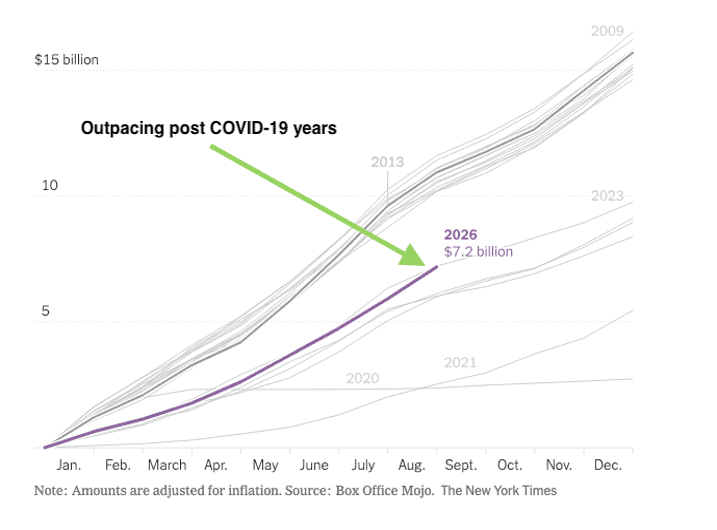
Streaming thinned out casual moviegoers and forced weaker operators out of business. The survivors turned moviegoing into a premium event business, and through November 24, 2026, domestic box office sales are up 21% year-over-year (YoY) and on pace for the best year since 2019.
This week’s Long Idea operates a leading private-label premium large-format (PLF) brand in the world and is actively taking market share in both the U.S. and Latin America.
Despite leading profitability and record 3Q26 results, the stock is priced as if the company’s profits will permanently fall.
Below, we provide an excerpt from our latest Long Idea report. Get the full report a la carte here.
This stock presents quality Risk/Reward based on the company’s:
- leading premium large-format footprint across the world,
- market share gains in the U.S. and Latin America,
- peer-leading ROIC across theater operators,
- strong free cash flow that supports recent dividends and repurchases, and
- cheap valuation that implies a permanent decline in NOPAT.
Streaming Didn’t Kill Theaters
In an interview with Semafor in early 2025, Netflix CEO Ted Sarandos stated:
“The theatrical box office is down 40 to 50% from pre-COVID, and this year is down 8% already, so the trend is not reversing. You’ve gotta look at that and say, ‘What is the consumer trying to tell you?’’
The proclaimed death of movie theaters was premature. See Figure 1.
Figure 1: Cumulative North American Cinema Box Office Revenues by Month: 2005-2026
Sources: New York Times and New Constructs, LLC
Premium Experiences Drive Premium Margin
Streaming may have killed off casual theater goers, but it did not kill off theaters. Instead, it pushed the operators to lean into their biggest advantage over the home theatres: offering a premium entertainment experience.
Cinema United estimates in its latest Cinema Investment Report that North American exhibitors have spent $2.7 billion in capex over the past two years, with the top 8 spending $1.8 billion alone.
In the past year, $1.2 billion was spent in reinvestment, with the top 8 spending $840 million over that time.
Those investments have gone to improving existing theater experiences, through enhancements such as:
- premium seating,
- new projectors,
- new sound systems
- full-service bars and kitchens,
- and new screens.
These improvements not only draw audiences but allow operators to charge premium prices, which enhances profitability across the industry.
Consistently Grows Profits
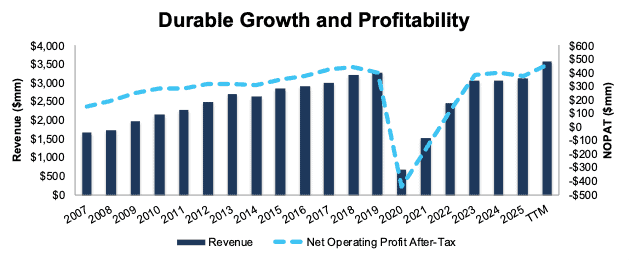
Since 2007, this company has grown revenue and net operating profit after-tax (NOPAT) by 4% and 6% compounded annually.
More recently, since 2021, the company has grown revenue by 20% compounded annually and NOPAT from -$158 million in 2021 to $457 million in the TTM. See Figure 6.
The company improved its NOPAT margin from -10% in 2021 to 13% in the TTM, while its invested capital (IC) turns, a measure of balance sheet efficiency, improved from 0.3 to 0.8 over the same time.
Rising NOPAT margins and IC turns drive return on invested capital (ROIC) from -3% in 2021 to 10% in the TTM. Longer-term, the company has improved its ROIC from 7% in 2015.
Figure 6: Revenue and NOPAT: 2007 – TTM
Sources: New Constructs, LLC and company filings
…there’s much more in the full report. You can buy the report a la carte here.
Or, become a Professional or Institutional member – they get all Long Idea reports.
Interested in starting your membership to get access to more of our research? Get more details here.