New Constructs provides investors with tools that aid the investment decision-making process by:
Making all companies financially comparable based on the lowest common financial
denominator: economics;
Quantifying market expectations by revealing the future financial performance required
for companies to justify stock prices;
Providing robust and high integrity valuation tools based on the economics, rather
than accounting, performance of businesses.
Our Company Models and Stock Screener offer investors the necessary tools to overcome the shortcomings of both
accounting measures of profitability and traditional valuation techniques.
New Constructs' products and services combine recent advances in computing power with New Constructs'
expert accounting and economic analytical skills. Our patent-pending financial model automates the laborious
tasks of data scrubbing and complex model building required to assess the true profitability and value of
businesses. By unearthing critical financial information buried deep within SEC filings, New Constructs'
system transforms accounting statements into Economic Financial Statements. The model enables true
"apple-to-apples" analysis of the profitability of businesses, despite the different accounting policies that
companies may employ.
In addition to custom reports and traditional research reports, New Constructs offers customers direct access to our Company Models and Stock Screener, which have direct access to our proprietary database.
Our Company Models provide customers access to the system's proprietary valuation models for all companies in
the S&P 500 and, eventually, the Wilshire 5000.
Our Stock Screener provides customers the capability to perform
searching and screening for stocks based upon the proprietary results created by the models.
Our Company Models make it quick and easy to analyze entire industries and sectors as well as screen the
entire S&P 500 for companies that meet an investor's specific criteria.
The accounting rules that govern financial reporting were not designed for equity
investors and are suited primarily for credit analysis. Hence, accounting statements do not provide an
accurate picture of a company's economic profitability nor its value.
GAAP earnings often significantly overstate a company's true profitability. Pro-forma earnings often push
profitability focus even further from the economic truth. New Constructs' proprietary valuation system
calculates the true economic earnings and Returns on Invested Capital (ROIC) that companies generate. New
Constructs' system also quantifies the large divergences between what companies report as profits and what
they actually generate. For example, the cost of annual Employee Stock Option (ESOs) issuances is higher than
100% of revenues for some companies and is a significant operating expense for others. The liability related
to outstanding ESOs claims as much as 5-10% of the market value of many companies.
The use of valuation short-cuts, such as "Price to EPS" and "Enterprise Value to EBITDA" multiples,
sacrifices analytical quality for speed. These types of valuation techniques often provide misleading results
for valuing stocks and any other assets.
Gathering all the correct data is the first step in translating GAAP reporting
into economic truth.
Using critical information from the Financial Statements in 10Ks, 10Qs, and press releases and the
Notes to Financial Statements, New Constructs accounting and finance experts translate reported GAAP
financials into economic earnings analysis. This process requires expert knowledge and interpretation of
accounting rules and economic principles.
Analyzing Economic Financial Statements Empowers Investors with Knowledge of the
Economic Performance of Business.
The Economic Financial Statements capture the comprehensive financial picture of a business and are
the foundation for an economic assessment of the profitability of any business.
These metrics provide investors with insight critical to assessing the merit of business models.
Understanding the true economic performance of businesses is the first step in valuing any business
model or strategy.
A disconnect between investment theory and investment
practice exists and is manifested in the way investors should value stocks versus the way they actually do
value stocks. New Constructs provides the tools to solve this problem.
Identifying the Problem: We still don"t know how to value companies.2
The problem with popular valuation techniques, such as price to earnings, price to revenues, and EBITDA
ratios, is twofold: they are shortcuts that fail in their attempts to supplant proper discounted cash flow
analysis, and they are entirely based on reported accounting data. Too many analysts and investors rely on
the face value of reported financial statements and base valuations on those numbers. Financial statements
were never designed for equity investors. They were created for accountants and creditors, who have different
financial priorities than equity investors. For this reason, it is not surprising that companies" stock
prices do not correlate with accounting metrics.
So What Drives Stock Market Valuation?
The value of any asset equals the discounted present value of its cash
flows.
As far back as the 1950s, Professors Merton Miller and Franco Modigliani proved that the stock market
equates the value of a firm to the present value of the future cash flows available to the firm"s owners.
Though this recipe for valuation seems quite simple, its execution can be difficult. Although the reported
financial statements (e.g., the Income Statement, Balance Sheet, and Cash Flow Statement) do not capture the
full picture of a company"s true financial performance, all of the necessary information is available. The
Notes to the Financial Statements found in the 10-K and 10-Q documents provide important disclosures
that affect the interpretation of the reported financial statements.
Why Haven't More Investors Followed Warren Buffett's Example or Miller and
Modigliani's Proof?
New Constructs' methodology is based on the view that economic cash
flow is the most important driver of asset value. In Figure 1 below, we use our discounted cash flow
framework to show how ROIC is the key valuation driver as measured by a Price to Earnings (P/E) multiple. The
results from the 20 different Earnings Growth and ROIC scenarios show that a company must achieve ROIC
greater than WACC (set to 10%) for growth to contribute to the value of a business. Growth has no impact on
value if the business' ROIC is equal to its WACC. Growing a business that earns a ROIC below WACC increases
the rate of value destruction.
When ROIC equals 10%, the same as WACC in Figure 1, the value of the business does not change no matter
how much the company grows. This result stems from the fact that a business with ROIC equal to WACC neither
creates nor destroys value. Growth from companies not earning ROIC above their WACC destroy value. The faster
a business with ROIC less than WACC grows, the more value it destroys resulting in a lower, eventually
negative, P/E multiple. Looking toward the right side of the chart reveals that a company with high revenue
growth and ROIC above WACC can be very valuable.
Key Takeaway investors must understand that the economics of a business are more important
than measuring a company's growth.
Figure 1
P/E Ratios That Result From ROIC and Earnings Growth Scenarios
Return on Invested Capital Is the Critical Driver of Value
Assumptions: WACC is 10% and Growth Appreciation Period or DCF Forecast Horizon is 20 years.
Source: New Constructs, LLC
The distinction between 'growth' and 'value' investment strategies
is irrelevant. Growth without profit (i.e. value) offers no investment merit. Conversely, value without
growth offers little upside incentive for investing in any business. New Constructs' methodology and tools
encourage investors to incorporate an assessment of both the growth and value of businesses into their
investment decision-making process. Figure 1 above clearly shows that there is no such thing as economic
profit growth without value creation. Growth without value leads to an economic and investment dead-end.
Value creation without growth means there is no economic earnings growth and the company is unable to extend
its Growth Appreciation Period (GAP). Investors must evaluate both the profitability (Economic
Profit Margin) and growth (Revenue CAGR) of businesses in order to make informed investment
decisions.
Once the economic profitability of a business has been accurately evaluated, one can build financial
models, grounded in bedrock financial theory, to compute the value of a business. Figure 1 below illustrates
the overall process New Constructs employs to value a company"s stock.
Figure 1
Analytical Process for Equity Valuation
Source: New Constructs, LLC
The Basic Valuation Recipe - Same for Every Asset
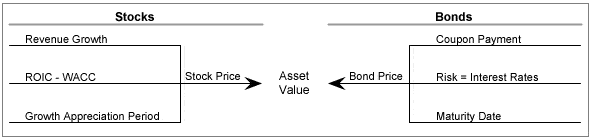
Figure 2 shows how the proper approach to value every type of asset is the same. In Figure 2, we compare
bond valuation with stock valuation to show how the relevant terms correspond to each other. Equity cash
flows, for example, mirror fixed income coupon payments. The Growth Appreciation Period for stocks is
analogous to the maturity date for bonds. Market risk for bond investors comes from interest rate
fluctuation. Market risk for equity investors is quantified by the Weighted-Average Cost of Capital
(WACC), which quantifies the risk assigned to the stream of cash flows. The key difference between bond
and equity valuation is that equity value drivers are based on expectations, rather than defined by debt
covenants.
Figure 2
The Basic Valuation Recipe - Same for Bonds and Stocks and Every Asset
Source: New Constructs, LLC
We can extend the framework to demonstrate more detailed financial analysis. Figure 3 shows how business
cash flows can be broken down into more intuitive financial terms like Revenue Growth and Return on Invested
Capital (ROIC).
Figure 3
The Key Ingredients of the Valuation Recipe
Source: New Constructs, LLC
Using Intuitive Terms
We can replace the cash flow variable and focus on the three variables with which investors are most
familiar. We can use these three terms to quantify the specific financial performance required to justify
stock prices for all companies:
New Constructs' company valuation engine applies the Cash Is King - The Truth About
the Value of Stocks methodology to reveal the future financial performance required to justify stock
market values. Figure 1 presents the results of our discounted cash flow analyses, which offers the results
of multiple combinations of the key value drivers. This valuation matrix reveals ('Market Expectations'
section) the financial performance required to justify Sample Company's market price of $14.6. Specifically,
it shows:
Revenue Growth- the Compounded Annual Growth Rate (CAGR) for
revenues that must be achieved over the Growth Appreciation Period (GAP). For the current
stock price of $14.6, this hurdle is 10%.
Economic Earnings Margin- the excess returns on capital that must be achieved
over the GAP. Note that this number is the average return level during the entire GAP and not the actual
level of returns at the end of the GAP. For this reason, the length of the GAP can drive results from
this calculation up significantly for longer GAPs, and it might seem unusually low for short GAPs. For
the current stock price of $14.60, the hurdle is 9%.
GAP (Growth Appreciation Period)- the number of years over which the company
must sustain the afore-mentioned Revenue CAGR and Economic Earnings Margin. For the current stock price,
this hurdle is 16 years. We arrive at this number by extending the forecast of our discounted cash flow
model as far into the future as needed to calculate a value equal to the current market
price.
Figure 1 - The Valuation Matrix
Source: New Constructs, LLC
In the box to the left of the financial performance required to justify 'market expectations', we provide
a summary of the 'historical performance' of the relevant value drivers.
Figure 1 also shows the financial performance hurdles required to justify prices 50% above and below the
current price. All of these calculations are based on Default Scenario projections provided by New
Constructs' analysts. The Default Scenario is a scrubbed and normalized extrapolation of historical
performance. We use this matrix in our valuation analysis of all the companies we cover. It is designed to
present New Constructs' clients with a streamlined summary of the financial hurdles companies must meet to
justify the market price or exceed to drive price appreciation.
Providing Context
In the "Historical Performance" section of Figure 1, a summary of the company's past performance is
displayed. Investors now have a context within which to judge the "Market Expectations" data. Juxtaposing the
historical performance with the required future performance shows how much the expected future performance
may or may not diverge from historical performance. The historical information provides insightful context
for investors to assess the likelihood of meeting, beating, or under-performing market expectations. In the
How New Constructs Discounted Cash Flow Model works section of this Help page,
New Constructs' proprietary Multiple Scenario Analysis capabilities are discussed. These scenario analyses
enable investors to assess the valuation sensitivity different companies have to the three key value
drivers.
Better To Be Vaguely Right Than Precisely Wrong
We do not assert that we can define the exact combination of value drivers implied by stock prices. We
attempt to present cogent combinations that, at the very least, enable investors to calibrate their valuation
analyses with greater accuracy and transparency than traditional tools.
New Constructs' discounted cash flow model calculates the value attributable to stock prices based on the
forecasted financial performance entered into the model. The model harnesses state-of-the-art computing power
to calculate a value per share for every year up to 100 years into the future. We do not believe that we can
forecast the future performance of a company into the future with any special accuracy. Our model focuses on
the market's expectations for future financial performance by matching the market price of a stock with
values calculated by the DCF model. In turn, we leverage our model to tease out of the stock price the stock
market's expectations for the future financial performance of a company. This insight enables investors to
calibrate their valuation assessment around the market's expectations. The burden of predicting the specific
performance of the core value drivers shifts to the market. Investors only can determine whether they feel
market expectations are too high, too low, or about right.
As displayed in Figure 1 below, our DCF model captures the Present Value of Future Cash flows
attributable to equity shareholders.
Figure 1
New Constructs' discounted cash flow model quantifies the cash flows produced during a company's Growth
Appreciation Period (GAP), which represents the value of the compan's assets. It can be calculated
based on free cash flows or economic earnings.
Source: New Constructs, LLC
Determining The Value Attributable to Shareholders.
Once the model calculates the "Present Value of the Business' Total Cash Flows," we know the present
value of cash flows available to all stakeholders. The next step, illustrated in Figure 2 below, is to
determine the value available to shareholders by adding the value of any non-operating assets and deducting
the value of any senior claims to the cash flows. Remember that value attributable to equity investors is
residual to that available to creditors and minority interests. In addition, we must account for the value of
outstanding options attributable to employees to determine the net value for current or prospective
shareholders.
Figure 2
Calculating the value available to shareholders: Quantifies the value created by the business that is
available to shareholders
The key difference between our DCF and others is that we calculate the value attributable to equity
shareholders over multiple (100) different time periods. In addition, our yearly calculations represent
different Growth Appreciation Periods (GAPS) because they are based on a Terminal Value that assumes the
company generates no future incremental profits. To be specific, our Terminal Value for each annual
calculation is a perpetuity calculation that assumes no future growth after each GAP. The formula is
NOPATt+1 divided by WACC. Using a Terminal Value that assumes no future profit growth enables our
DCF model to calculate the specific value of companies implied by each Growth Appreciation Period.
See Figure 3 for a graphic representation of how our model's dynamic discounted cash flow analysis
calculates the value of a business and the attendant value available to shareholders for multiple Growth
Appreciation Periods. This chart shows how the value of the company analyzed in this example rises as its
Growth Appreciation Period increases. The 'Market Implied GAP' equals the Market-Implied Growth Appreciation
Period implied by the current market price. Our model calculates the 'Market Implied GAP' by matching the
current stock price with the year that the DCF value matches that of the current stock price. For example,
the 'Market Implied GAP' for the company in Figure 3 is 16 years. Our model can also calculate the GAP
implied for target prices as well as any other stock prices no matter how great or small they may be. The
analysis in Figure 3 shows DCF values for only 35 years though the model values companies for 100 years into
the future.
Figure 3
Results of the Dynamic Discounted Cash Flow Calculations: Company Models calculate the GAP implied
by the current stock price
Source: New Constructs, LLC
Figure 4 is a copy of the Valuation Matrix provided on the Company Model Decision
Page.
Figure 4
The Valuation Matrix
Source: New Constructs, LLC
Figure 5, below, presents a copy of the DCF model used to generate the values in Figure 4.
Figure 4 also shows how our DCF model calculates values for multiple forecast horizons or Growth
Appreciation Periods. These values provide the data needed to generate a chart like the one above and like
the valuation matrix as presented on the Company Model Decision Page. Note the highlighted sections in Figure 5 and
how they jibe exactly with the Revenue CAGRs, Economic Earnings Margin, and GAPs presented in Figures 3 and
4.
Figure 5
Sample Dynamic Discounted Cash Flow Model for Sample Company
Buy Low Expected Cash Flows; Sell High Expected Cash
Flows.
Material changes in the present value of expected cash flows are the key driver of material
changes in a stock price. Accordingly, determining the investment merit of a given stock boils down to
identifying gaps between the investor's expectations for future financial performance and the market's
expectations. Our methodology focuses on comparing the valuation impact of multiple forecasts scenarios and
measuring the different valuation impacts they create. We offer investors the ability to identify those
stocks where the market's expectations are significantly different from their own with greater accuracy and
reliability.
Figure 1 provides investors with the information needed to make informed decisions about a company's
valuation. With this information, investors can determine whether or not they:
Agree with market expectations and believe a stock is properly valued;
Believe market expectations are too high and a stock is overvalued;
Believe market expectations are too low and a stock is undervalued.
New Constructs does not attempt to predict the future performance of businesses
or stock prices. Our focus is to present a methodology that empowers investors with information essential to
assessing the true profitability and value of companies.
We subscribe to the valuation philosophy articulated so well by Martin Liebowitz:
"At the very most, the modeled result should be taken as delineating the region beyond
which the analyst must rely on imagination and intuition."
"The results of any equity valuation model should be viewed only as a first step in a
truly comprehensive assessment of firm value."
"Analyzing a firm's future is akin to assessing the value of a continually unfinished
game in which the rules themselves drift on a tide of uncertainty."
Company Models perform no subjective or qualitative strategic analysis. Instead, they focus on
providing the quantifiable financial context critical to performing subjective and qualitative analyses more
effectively. In essence, New Constructs offers a methodology that provides a better understanding of the
economics of businesses. We hope investors can use these insights to perform a more accurate strategic
analysis in order to determine if a business can exceed the market's implied expectations for future
financial performance.
We do not make investment recommendations. Instead, we present investors with a robust assessment of the
quantitative pros and cons for making an investment in each of the stocks we analyze.
A Good Bargain Is Hard To Find
Most of our Company Models do not reveal any 'cheap' stocks. We underscore that finding undervalued stocks
(i.e. good investment opportunities) is not a simple task. The market is a very robust pricing mechanism.
Consistently finding inappropriately valued stocks is a challenge that few professional investors meet.
Indeed, Warren Buffett, one of the most successful contemporary investors, employs an investment strategy that
reflects this fact. He has often noted that finding under-valued stocks is difficult especially at market
peaks. Accordingly, his investment strategy focuses on making large investments in the few stocks he
considers attractive. New Constructs aims to help investors more systematically identify those few, rare
potential "bargains".
There are several sources for the data inputs required to develop Company Models.
They are divided into two categories:
Historical Data
10-K filings are the primary sources, and provide all the information required
to perform historical analyses in our Company Models. Note that New Constructs pulls critical
information from all Financial Statements in addition to the Notes to Financial Statements and
Management's Discussion and Analysis section of 10Ks and 10Qs. Indeed, the Notes to Financial
Statements and Management's Discussion and Analysis provided the information required to convert accounting
results into true economic results.
Credit Ratings are provided by S&P.
Stock prices data come from Commodity Systems, Inc. (CSI).
Forecast Data
The Default Scenario is created by New Constructs analysts to provide the most
useful results for clients.
The Default Scenario estimates are derived from analysis of historical
performance and historical trends for each company. For every company, long- term (26 years and
beyond) Revenue Growth estimates revert to a mean of 6.5%, which equals the average nominal GDP
growth rate since 1929. Other estimates (including pre-tax profit margin, tax rates and capital
requirements) are usually held constant over the entire forecast period.
There are a discreet number of calculations for which we created special
algorithms to accommodate three unavoidable data issues that impact the creation of an accurate database of
financial information:
Only a finite number of historical years of financial information can be entered into
any database of financial data.
Certain data points are inherently volatile and cause unwanted volatility in the
calculation of certain metrics.
We do not apply adjustments for the tax impact of non-operating expenses or income to
our NOPAT calculation if the Adjusted EBITA is less than or equal o zero. If there is no taxable income,
it follows that NOPAT should incur no tax impact from the exclusion of non-operating expenses or
income.
The specific algorithms that address the data anomalies mentioned above along with the calculations they
affect are:
Change in Reserves for the first year of history that we present. We cannot
calculate an accurate change in LIFO, Loan Loss or Other Non-Cash Reserves for the first year of
historical analysis we perform because we do not have the prior year data. We set the values to zero
in these cases.
Goodwill Amortization for the first year of history that we present. If
companies do not report their Goodwill Amortization expense in the Income Statement, the Statement of
Cash Flows or the Notes to the Financial Statements, our system makes the Goodwill Amortization expense
equal to the annual change in the Accumulated Goodwill Amortization value. We cannot calculate an
accurate change in the Accumulated Goodwill Amortization value for the first year of historical analysis
because we do not have the prior year data. The value accumulates starting from our first year of
coverage.
Marginal Tax Rates as calculated based on the Pre-Tax Income and the Income Tax
Provision provided in the 10K and 10Q Income Statements can be volatile from year to year. Our system
accommodates this anomaly by applying the following rules: any time the Marginal Tax Rate calculation
yields a value below 0.0%, our system assumes it is 0.0%; any time the Marginal Tax Rate is greater than
40.0%, our system assumes it is 40%. These system rules affect NOPAT via the calculation of tax impacts
of ESO expenses, Implied Interest from the Capitalization of Operating Leases, and non-operating expenses
and income. These system rules affect Invested Capital via the calculation of the After-Tax value of
asset write-downs.