
In our view, this limited-service restaurant IPO is a lose-lose proposition for public investors. In this transaction, the proceeds go to pay off private equity investors without giving public investors any voting control for their money.
When we look past the headlines, we see that this company is a bad business. It generates a near industry-low ROIC, presents misleading profits, and operates with multiple conflicts of interest that should give investors pause.
We think the targeted valuation is far too high because it implies the company will significantly improve margins while growing revenue to levels rarely achieved across the food industry.
Below, we provide an excerpt from our latest Danger Zone report. Our IPO research differs from the street and has saved investors from losing big money on many of the worst IPOs, including Beyond Meat (BYND), WeWork (WE), Peloton (PTON), Klarna (KLAR), Allbirds (BIRD), Didi Global (DIDI) and more.
Get the full report a la carte here.
We recommend investors avoid this IPO based on the company’s:
- no IPO proceeds for growth, all going to private equity investors, and no real voting power,
- no auditor’s opinion on Internal Controls,
- misleading non-GAAP reporting,
- numerous conflicts of interest, and
- expensive projected IPO valuation.
Red Flag #1: Misleading Non-GAAP Results
Unprofitable companies seem to love non-GAAP metrics because they make them appear more profitable than they really are and, hopefully, help drive a higher valuation. This company is no different.
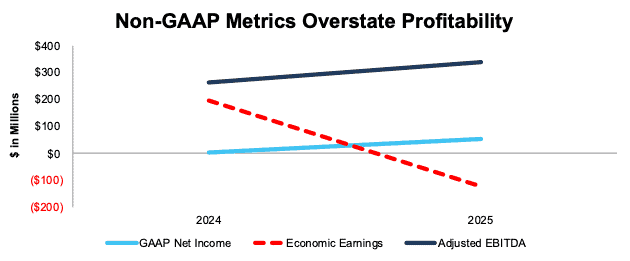
The company provides investors with Adjusted EBITDA and Adjusted EBITDA less Capital Expenditures. Not surprisingly, these non-GAAP metrics present a more positive picture of the firm’s business than GAAP net income and our proven superior economic earnings.
For instance, the company reports adjusted EBITDA of $339 million in 2025. Meanwhile, GAAP net income is $55 million and economic earnings are -$122 million. See Figure 4 from the full report.
Figure 4: Adjusted EBITDA, GAAP Net Income, and Economic Earnings: 2024 – 2025
Sources: New Constructs, LLC and company filings
Red Flag #2: We Don’t Know if We Can Trust the Financials, Yet
As a private company, this company is not required to comply with the SEC rules that implement Section 404 of the Sarbanes-Oxley Act and is therefore not required to make a formal assessment of the effectiveness of its internal control over financial reporting.
The company will be required to provide a report on the effectiveness of internal controls beginning with its second annual report following its IPO.
The company’s auditor, Deloitte & Touche, is required to obtain an understanding of internal controls, but not for the purpose of expressing an opinion on the effectiveness of the company’s internal controls. As a result, the auditor issues no such opinion. Without an auditor’s opinion on the effectiveness of internal controls, investors are left in the dark until there is one.
Should a weakness in internal controls arise, the risk that the company’s financials are fraudulent and/or misleading increases. As the S-1 notes “if management or our independent registered public accounting firm determines we have a material weakness in our internal control over financial reporting, we could lose investor confidence in the accuracy and completeness of our financial reports…”
…there’s much more in the full report. You can buy the report a la carte here.
Or, become a Professional or Institutional member – they get all Danger Zone reports.
Interested in starting your membership to get access to more of our research? Get more details here.