

For years, the AI boom has run on the assumption that capital would always be readily available, whether through cheap debt, bottomless private-credit, or an IPO window to cash out and raise billions more.
However, as the realities of the AI race grow clearer, that assumption is being stress-tested across all funding sources.
As the AI companies’ off-balance sheet hidden debt surpasses the net exposure in the credit default swap market prior to 2008, investors must ask themselves: at what point does “smart” money stop throwing capital at a cash burning endeavor? If the answer to that question is anytime in the foreseeable future, then investors must prepare for the consequences of no more fresh capital to continue the AI spend.
What’s the Problem: 20-45% Downside in Stocks
If AI liquidity dries up, and there are clear signs it is, we see large, 20%, downside risk in the S&P 500, with most of that concentrated in the valuation of AI-related stocks. How do we quantify the risk?
We start with the $1.4 trillion of hidden earnings expectations (detailed in The New Constructs Most Wanted List: Worst AI Earnings Manipulators). We assume that the AI companies meet 50% of the that expectation, or $700 billion. We multiply that by the forward P/E of the S&P 500 (21x) to get $14.7 trillion, or the value of those lost hidden earnings expectations. That’s roughly 21% of the aggregate market cap of the S&P 500 and ~45% of the market cap of the 15 largest AI companies. If economic returns on AI spending end up higher, then the downside is lower. And, vice versa.
The Government Can’t Save Us This Time
Unlike the Great Financial Crisis and the COVID crisis, a government bailout is not a solution for many reasons, but primarily because the U.S. government has largely maxed out what it can spend, as evidenced by the recent treasury selloff. Even if the government were in good standing with bond investors, we don’t think it would have the means to fill the hole of $700 billion to $1.4 trillion of unfulfilled earnings on AI investment.
Mounting Warning Signs of the Retreating Liquidity
In hindsight, it’s easy to pinpoint an exact moment a major liquidity squeeze begins. Predicting that moment in real-time is much more difficult. We’re not here to try and predict exactly when the market pulls the plug, but we are seeing enough small liquidity squeezes emerging across the market to believe the liquidity tide has turned and is starting to go out. It will not be long before, as Warren Buffet says, we will see who’s wearing a bathing suit. In the meantime, we think the risk/reward of the AI trade has shifted, and investors should take their profits now.
Warning Sign #1: Delayed IPOs
The clearest sign of tightening liquidity is also the most public facing. AI and AI related companies are delaying their IPOs due to investors balking at lofty valuations. Private market AI investors are telling public investors that these companies are worth billions, and investors are saying “no.”
First, the two “elephants in the room” continue to delay their IPOs. Anthropic has delayed its IPO from an originally expected October 2026 launch to November 2026. OpenAI has ruled out an IPO in 2026 entirely, after original expectations for a public offering in 2026.
Anthropic and OpenAI are not the only ones hitting the pause button.
SB Energy, a Softbank Group subsidiary and NVIDIA investment is reportedly putting its IPO on hold as it failed to find enough buyers at its targeted $50 billion valuation.
Holtec, a nuclear energy firm with plans centered around providing power for AI data centers, announced on September 17, 2026 it was indefinitely postponing its IPO. The company noted the postponement is a result of an “unusual confluence of developments that has impaired investor confidence in the market for new public offerings.”
Aggreko, a provider of power generation, heating, cooling, and energy services, and is growing directly in the AI data center space is reportedly slowing down its IPO process because of the challenges facing the data center sector.
Warning Sign #2: Skyrocketing Borrowing Costs
CoreWeave (CRWV) is a perfect case study in what happens when a leveraged AI infrastructure company meets a less liquid credit market. In August 2026, CoreWeave closed a $2.6 billion delayed-draw term loan. The loan cost 100-125 basis points more than originally floated, which pushed the total borrowing cost to ~10.4% a year.
In addition, lenders extracted real concessions and protections. Under the terms, CoreWeave has to keep a cash cushion on hand, maintain income at specific levels above debt payments, and pay down the loan steadily through 2031, rather than all at once.
As Bruce Richards, chief executive officer of Marathon Asset Management, put it, guardrails like amortization and covenant controls are something “you haven’t seen in a very long time.”
CoreWeave isn’t alone. Bloomberg reported that three other, non-AI companies also had to offer better terms to complete their issuances, as the entire leveraged-loan market tightens.
Then, in late September, SoftBank Group closed on $11.1 billion in “the largest corporate junk-bond offering on record”, including a 3.5-year bond at a yield of 8.625% and a 7.5-year bond at a yield of 9.75%. Bloomberg reports “the yields are the highest-ever for SoftBank dollar bonds.”
Bond markets are speaking, and loudly. AI financing is getting riskier, and bond investors are demanding higher yields and concessions to provide additional capital.
Warning Sign #3: All-Time Highs for Hyperscaler Credit Spreads
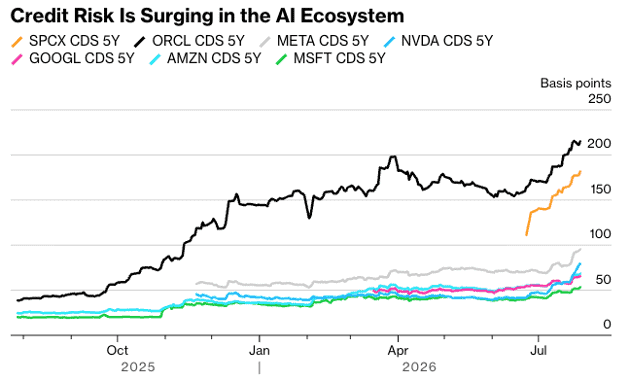
Credit default swaps spreads tied to Alphabet (GOOGL), Amazon (AMZN), Meta (META), NVIDIA (NVDA), Oracle (ORCL), SpaceX (SPCX), and Broadcom (AVGO) have all risen sharply over the past year. In fact, Alphabet’s five-year CDS spread hit a record high in July 2026.
Higher spreads indicate increased concern about a company’s ability to pay down its debt. With trillions on the line, it’s not surprising concerns are rising.
Figure 1: Rising CDS Spreads for Hypsercalers
Sources: Bloomberg
Warning Sign #4: Rising Risk-Free Rate
When the baseline risk-free-rate rises, borrowing costs for every company, AI included, rise too.
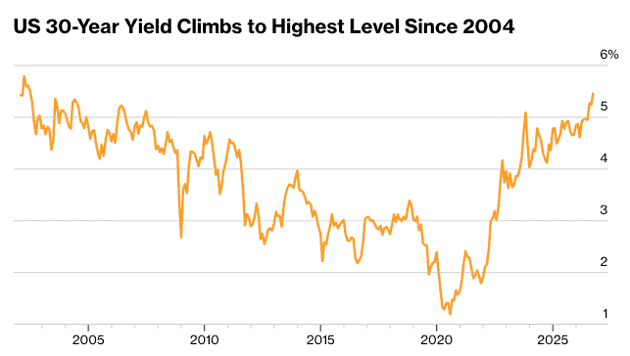
Low demand for a five-year Treasury auction pushed yields above 5% for the first time since 2007 while the 10-year rate increased the most since “Liberation Day” in April 2025. The swaps market now implies that investors expect three quarter-point hikes over the next year. Just a day later, the 30-year treasury yield rose to its highest level since 2004.
In other words, the floor under all borrowing costs is rising, and AI companies raising debt on top of that floor are financing the buildout at a higher cost than they were a year ago.
Figure 2: Rising 30-Year Treasury Yield
Sources: Bloomberg
Warning Sign #5: Private Credit Firms are Limiting Withdrawals
Private credit funds are one of the primary funding sources for data center and AI-infrastructure in recent years. However, investors in those funds have attempted to pull their money out faster than the funds are structured to return it. These investors want their money back, not a good sign for future funding.
In late September, Apollo Debt Solutions limited redemptions for its flagship private credit fund for the third consecutive quarter. The firm capped withdrawals at 5% of outstanding shares yet received redemption request for ~15% of its stock.
Earlier in the month, Blackstone Private Credit Fund enforced a 5% limit on redemptions even as redemptions hit 10% of shares. Redemptions have exceeded the standard limit for three straight quarters as well.
In early July, Blue Owl Capital also enforced its 5% redemption limit for two of its private credit funds as redemptions exceeded the cap in the quarter. In the first quarter, Blue Owl Capital reported Blue Owl Credit Income Corp received redemptions against ~22% of shares outstanding.
The enforcement of redemption limits comes after years of riskier loan issuances. S&P Global notes that private credit lending has exceeded broadly syndicated loan issuance for B- and below borrowers for four consecutive years. Additionally, U.S. maturities of B- and below debt will surge to $215 billion in 2028, up from ~$57 billion 2026, which will create additional refinancing headwinds for already leveraged borrowers.
Warning Sign #6: Delayed Revenues Due to Political Pushback
Beyond financing costs, political resistance is slowing data center projects and connections to the grid, which delays the revenues sorely needed from these huge AI investments.
On September 21, 2026, Texas Governor Greg Abbott directed the Texas Commission on Environmental Quality to “halt all permits sought by data centers.” The latest move follows orders in both June and August when he directed the Public Utility Commission to require data centers fully fund the cost of electric infrastructure and announced a moratorium on the approval of data centers until public regulators could audit each data center’s plan to connect to the state’s electric grid, respectively.
A moratorium is a complete shift in stance since November 2025, when Greg Abbott noted “Texas is the epicenter of AI development, where companies can pair innovation with expanding energy.”
Regulatory friction is slowing development in New Mexico too, and Oracle is now looking to shield itself from rising costs. According to Bloomberg, Oracle sent a notice citing force majeure in an attempt to put off payments should the Project Jupiter data center fail to come online in 2028. The project in New Mexico was part of the Stargate AI build out announced by President Donald Trump alongside Oracle, OpenAI, and SoftBank.
Bloomberg notes that the project “has hit serious setbacks including the denial of a permit key to its plans for energy resources.”
Broadly, public opinion on data centers has declined throughout the year. The two examples above highlight how data center and AI projects now face longer, less certain permitting timelines on top of rising financing costs highlighted above. The last thing these AI projects need is delay.
Warning Sign #7: Rising Energy Costs Reducing Future Profits
Energy costs are rising, and money that has to cover those higher energy costs elsewhere is money that can’t go toward AI infrastructure, debt servicing, or new funding rounds.
Diesel prices across the globe are reaching record highs amid ongoing global supply disruption. Europe, which is largely dependent on energy imports, is also facing a jet fuel supply deficit in 4Q26. In the U.S. the White House is considering diesel-export restrictions, rather than outright ban exports. Experts have warned that such actions could actually cause domestic producers to cut output and fail to address the actual issue driving higher prices, which is a global supply shortage.
When energy costs spike, capital must get diverted to cover them, which tightens the liquidity pool for other investments, including AI.
Why It Matters Now
Nearly every source of AI funding is showing signs of stress at the same time.
Meanwhile, the AI companies dependent on these funding sources are still trading as if “all systems go.”
The reason we’re not seeing immediate capitulation in these stocks is that it’s in Wall Street’s best interest to keep these names propped up as long as they can. Billions in fees are on the line with the Anthropic and OpenAI IPOs, and Wall Street needs time to unwind investments, transfer risk, and get institutional capital out of harm’s way before the reckoning. Just like in the Shorts turn the tables on Wall Street scene in the Big Short.
How long they can delay the economically inevitable is not clear. But, as we see liquidity squeezes increase and continue, we inch closer to the “straw that breaks the camel’s back.”
This article was originally published on September 25, 2026.
Disclosure: David Trainer and Kyle Guske II receive no compensation to write about any specific stock, style, or theme.
Questions on this report or others? Join our online community and connect with us directly.