

Upwards of 80% of the global population lives in “developing countries.” These countries need access to cheap fuel and energy, which lowers the cost of nearly all goods, to continue matriculating into the developed world. While the wealthiest nations strive for net-zero targets, the majority of the world population needs cheaper fossil fuels and will drive overall demand for refined products higher across the next decade.
To be clear, we believe, along with energy experts, that demand for refined petroleum products will rise, not fall, over the next decade.
Structural global supply constraints and a persistent secular decline in refining capacity are powerful tailwinds for domestic refineries. The record profits won’t last forever, but strong profits can continue for much longer than the market implies.
This week’s Long Idea stands out as a premier beneficiary of these dynamics.
Below, we provide an excerpt from our latest Long Idea report to show how our research finds opportunities the market is missing. Get the full report a la carte here.
This stock presents quality Risk/Reward based on the company’s:
- position to profit from widening crack spreads,
- ability to serve long-term demand for refined fossil fuel products including jet fuel, gasoline, and diesel,
- access to cheaper feedstocks,
- extended growth runway from renewable diesel and sustainable aviation fuel,
- strong shareholder return backed by best-in-class profitability and consistent cash flow generation and,
- cheap valuation that implies a permanent profit decline.
U.S. Refining Capacity Is Shrinking
The U.S. refining industry has undergone significant consolidation over the past several decades, with the number of operable refineries declining from more than 300 facilities in the early 1980s to roughly 130 today.
Since 2020 alone, the U.S has lost several refineries representing more than 550K (b/d) of capacity. These closures have resulted in a decline in global refining capacity. In 2022, estimates peg global refining capacity at 108 million barrels per day. In 2025, global refining capacity was ~104 million barrels per day.
No one has initiated any meaningful greenfield refining projects in decades, and we strongly doubt that any firms are willing to invest in development of new refineries given that “peak” demand is on the horizon. Even if that peak is a decade away, it might not be long enough to earn an adequate return on the large amount of capital required to build a new refinery.
Figure 2: Operable U.S. Refineries: 1982 – 2025
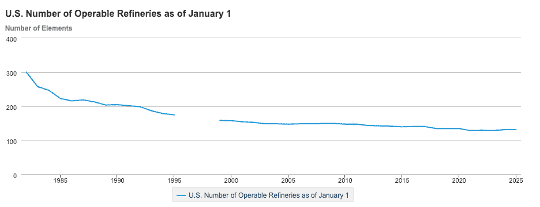
*EIA does not report the number of operable refineries in 1996 and 1998, which creates the gap in Figure 2.
Sources: U.S. Energy Information Administration (EIA)
Supply Constraints Create Sustainable Margins
Tightening global fuel inventories and refinery closures continue to support a favorable margin environment for refiners.
The EIA expects distillate inventories to remain below historical averages through 2026 and 2027, while refinery utilization rates already operate near practical capacity limits. More specifically, the EIA noted in its July 2026 Short Term Energy Outlook, “Ongoing tightness in gasoline inventories will support the crack spread for gasoline as we expect the wholesale price of gasoline will not fall as quickly as the price of crude oil.”
At the same time, disruptions tied to the Middle East conflict have materially tightened refined product markets, with jet fuel prices rising well above historical averages and diesel crack spreads remaining well above 2025 levels.
Even if geopolitical tensions ease, depleted inventories, limited global refining capacity, and structurally tighter fuel markets continue to support elevated refining margins.
Goldman Sachs stated plainly “we expected gasoline and especially diesel stocks to decline further in the initial Hormuz reopening stage as demand likely recovers more quickly than refined product supply.”
Refiners are particularly well-positioned to benefit from widening crack spreads, too. Even before the U.S. – Iran war, the EIA projected crack spreads to rise in both 2026 and 2027, which supports improved profitability for cost-effective refineries. Longer-term, S&P Global projects crack spreads will remain higher than historical averages through 2030, in large part because the “peak” in “peak gasoline demand” continues to increase.
Strong Fundamentals
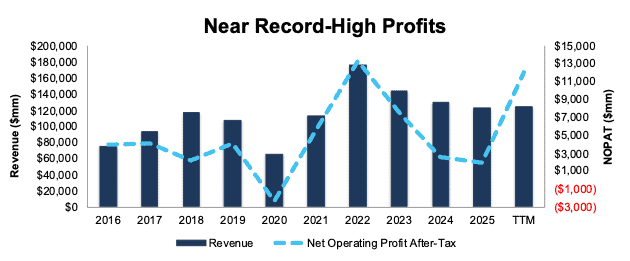
The company has grown revenue and net operating profit after-tax (NOPAT) by 6% and 13% compounded annually since 2016, respectively. See Figure 5 from the full report. The company’s NOPAT margin improved from 5% in 2016 to 10% in the TTM while invested capital turns improved from 1.6 to 2.1 over the same time. Rising NOPAT margins and invested capital turns drive the company’s return on invested capital (ROIC) from 8% in 2016 to 21% over the TTM.
More recently, the company has grown revenue and NOPAT by 2% and 20% compounded annually, respectively, since 2021.
Figure 5: Revenue and NOPAT: 2016 – TTM ended 1Q26
Sources: New Constructs, LLC and company filings
Strong Cash Flows Support Capital Return
Importantly, the company’s rising FCF supports the capital return to shareholders highlighted in the full report.
The company generated a cumulative $33.9 billion (33% of enterprise value) in free cash flow (FCF) from 2016 through 1Q26.
More recently, the company generated $27.6 billion in FCF from 2021-1Q26, or 14% more than the $24.3 billion spent on dividends and repurchases.
…there’s much more in the full report. You can buy the report a la carte here.
Or, become a Professional or Institutional member – they get all Long Idea reports.
Interested in starting your membership to get access to more of our research? Get more details here.