

News of improvements in Kimi 3 and other open-source models has the AI industry up in arms. The initial reaction, led by Anthropic, OpenAI, and their investors, is to lobby our government to restrict access to these models. Saner minds like Jensen Huang (see his letter on why open models matter) are standing up for free market principles to allow competition to drive faster improvements in and greater value from AI.
We’re not sure who will win, but we are sure of one thing: people will not pay a premium price for products that do not produce premium value for long. Anthropic and OpenAI’s pure-play AI model business models are in the Danger Zone this week because we think their potential IPO valuations (~$1 trillion each) will crater as the market digests the implications of drastically lower prices for similar capability from open source models.
Economics 101: Price Reflects Value
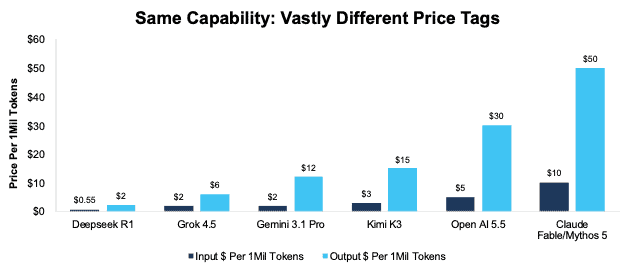
Per Figure 1, Claude Fable 5 and Mythos 5 cost ~18x more than DeepSeek R1 for input tokens. For output tokens, the gap jumps to 23x higher. Would you pay an 18x premium for anything that does not offer a commensurate improvement in value?
If these frontier models were clearly better, they could defend their price gap. In reality, benchmark testing proves the lower cost models deliver equal or better performance, at a fraction of the cost. In other words, Chinese models are outpacing American counterparts on both quality and pricing.
As Chamath Palihapitiya put it on CNBC, “we have the same input that has this crazy cost. If you’ve made a bet very early around one of these folks that are selling extremely expensive barrels of intelligence, and you try to pass through the cost, you may run into some downstream difficulty.”
In other words, it’s tough to make a straight-faced argument for investing in businesses like OpenAI and Anthropic that charge significantly more for a product produced and sold for much less by multiple competitors.
Figure 1: Per-Token Pricing Between Different Frontier Models
Sources: xAI, Anthropic, OpenAI, Moonshot AI, DeepSeek, Google
The Problem Remains the Same: Same Data, Same Ceiling
As long as frontier labs train on the same largely unvetted internet database as their Chinese competitors, there is no durable basis for a premium price. In other words, if all the AI models use the same dirty internet data, why pay more for one versus another? The premium priced models must be outperforming their cheaper counterparts to justify the premium, right? Wrong.
Rather than face the music about the disparity in price/value, Dario Amodei and Sam Altman stage publicity stunts about how their models are so powerful that that government needs to prevent the public from accessing them, e.g. the recent OpenAI/Hugging Face debacle.
The bottom line: Compute is a commodity. Parameter counts are a commodity.
The one input that hasn’t been commoditized is clean, structured, and accurate data.
This isn’t a new idea. In fact, we stated “To build real artificial intelligence (AI), high-quality training data is arguably the single most important ingredient.“ in Forget Chips, AI Firms Need Higher Quality Data to Win, which we published on July 21, 2025. Our thesis only grows stronger and collects more support as time passes.
- Larry Ellison noted on Oracle’s December 2025 earnings call that today’s frontier models “are all basically the same.” He further argued the only moat left is secure access to proprietary enterprise data.
- Alex Karp and Shyam Sankar, CEO and CTO of Palantir, echo the argument: “The Ontology is the body to the AI brains…Your agents can go nowhere without Ontology.”
- Chamath Palihapitiya (emphasis added): “the capability gap between the best open-weight/source models and the best closed models has narrowed much faster than the pricing gap. The pricing gap remains enormous while the capability gap is quite narrow.”
As we’ve articulated many times, AI is just like any other model. Garbage in – garbage out. As long as AI is fed poor training data, AI’s capabilities are limited. Currently, all the AI models face the same limitations because they use the same training data.
How To Produce AI That Deserves Premium Pricing
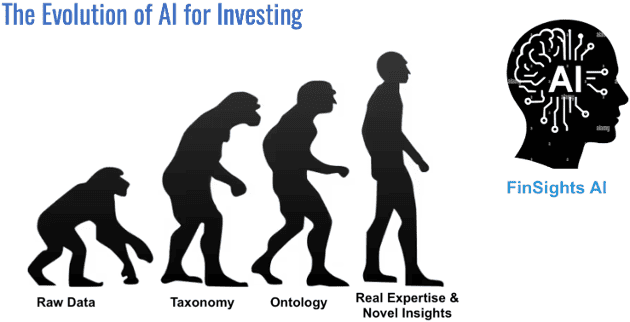
We’re not here only to poke holes in popular investment narratives. We’re here to provide solutions, too. For example, here’s the process to convert raw data into real, valuable insights that can support an AI for which investors might pay a premium price:
Raw data –> Taxonomy –> Ontology –> Real Expertise/Novel Insights.
Figure 2: How To Create Value with AI
Sources: New Constructs, LLC
Raw data is what every frontier lab already has: scraped text, filings, forums, or books.
Taxonomy is the hard work of organizing that data into a system that accurately and consistently categorizes the data according to its true meaning.
Ontology is mapping the taxonomized data into relationships and patterns that create value.
Only after this data conversion process can a system produce real insight. In the financial world, this insight comes in the form of idiosyncratic alpha.
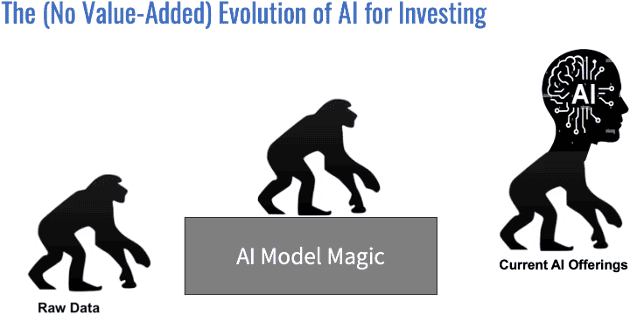
By focusing on the infrastructure spend (datacenters, compute, chips, etc), the AI companies are trying to distract you from the fact that they lack the quality data and ontologies to support AI that creates value. Their process looks more like Figure 3, which cuts out the two most important steps to drive real insights from raw data.
They market fluency as expertise, even as their systems continually lie to you. As an investor, this might sound familiar. It’s the same shortcut Wall Street research has taken for decades: skip the diligence, sound authoritative, profit off an unsuspecting investing public.
Figure 3: How Not to Create Value with AI
Sources: New Constructs, LLC
Putting our Money Where Our Mouth Is
The hard work of building a taxonomy and ontology to drive real insights, the kind that would be worth spending 10x or more for, isn’t just a pipe dream.
We built our Robo-Analyst technology specifically to convert raw data into insights that create alpha. And, we have proof that we succeeded.
- The Journal of Financial Economics, Harvard Business School, MIT Sloan, and Ernst & Young published papers proving the alpha available in modern, more accurate fundamental datasets..
- Three live-traded indices based on our proprietary data that outperform the market.
- Google Cloud recently invested millions of dollars to build an AI Agent for Investing, called FinSights AI, to demonstrate the art of the possible when their AI was powered by our superior fundamental data.
FinSights AI is the first and only truly reliable AI for investing. We think it’s worth paying a premium for. You can get details here.
We’re on record advocating the importance of data and ontologies starting in April of 2018. And, we’ve been beating that drum ever since.
This article was originally published on July 27, 2026.
Disclosure: David Trainer and Kyle Guske II receive no compensation to write about any specific stock, style, or theme.
Questions on this report or others? Join our online community and connect with us directly.