

Anthropic’s IPO is an unprecedented test of investor gullibility. Never, in the history of the world, have we seen an IPO valuation this high or one with as much risk. As more information leaks, including the pre-IPO prospectus, the picture becomes clearer: Anthropic is a money losing business hoping to raise billions from public investors, all while claiming its products could ultimately destroy the lives of those same public investors.
Not long ago, companies did IPOs to fund their next stage of growth. Today, Anthropic, like SpaceX (SPCX) a few months ago, is IPOing to pay off early investors and to fund its huge cash burn. We wonder, is this Wall Street’s Final Cashout? Currently, Wall Street appears ready to run the same playbook for OpenAI in 2027. Our hope is that investors stop taking the bait with Anthropic.
In fact, as we write this report, we’re reminded of WeWork Is the Most Ridiculous IPO of 2019, the report we wrote in August of 2019. Just a few weeks later, Wall Street cancelled the $47 billion WeWork offering, and SoftBank, WeWork’s owner, marked the asset on its books at $4 billion. Eventually, WeWork went bankrupt.
While Anthropic offers more to society than WeWork ever did, at a $2 trillion valuation, its IPO presents far bigger risks and is positioned to be a far bigger rip off of U.S. capital markets.
While we were not fortunate enough to be one of the few to whom Anthropic’s S-1 was selectively disclosed, the reports of the leaked financials reveal more than enough to assess the gargantuan risks of investing in this IPO.
As we will show below, the purpose of this IPO is to create exit liquidity for private equity and Wall Street insiders not wealth for public market investors.
We recommend investors avoid this IPO based on the company’s:
- warning, in its own prospectus, that is poses “a catastrophic or existential risk to humanity”,
- billions in reported losses and $518 billion more in contractual commitments,
- bottomless need for cash, even after raising $120+ billion in private capital,
- vastly overpriced valuation, which implies the company must generate 1.4 times the combined TTM revenue of the seven largest AI companies and 2x the TTM profits of Nvidia (NVDA), the most profitable tech company in the world.
In short, we don’t think Anthropic has a viable business. Since the arrival of open-source models, it’s been clear that the closed models would struggle to generate profits.
We detail more specifics on this issue and other reasons to avoid this IPO, including a chart of our reverse discounted cash flow (DCF) model to show the math behind why the targeted $2 trillion valuation is ridiculously too high.
Fundamentally Broken Business Model
Revenue Growth Without Profits Creates No Value. Anthropic’s revenue growth over the last several months is impressive. The company grew revenue twelvefold in 2025 to ~$4.6 billion. According to the New York Times, Anthropic is on pace to generate $100 billion in annualized revenue by the end of 2026.
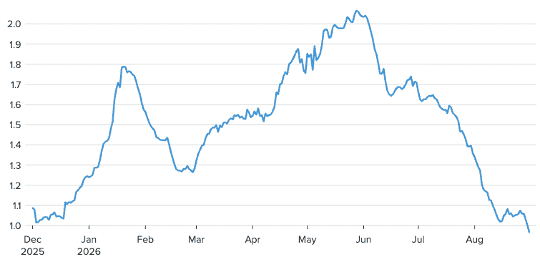
At the same time, we’ve seen a dramatic decline in token pricing. The LLM Token Expenditure Index, which tracks the going rate for a large language model token, has fallen from $2.04 in late May 2026 to $0.97 at the end of August 2026. As of October 4, the index was down to $0.96.
Given the already negative margins with high token prices, this dramatic decline suggests that both Anthropic and OpenAI will struggle to ever squeeze a penny of profit out of their AI revenue.
As more investors realize that Anthropic’s business model has no pricing power, they will understand that no amount of revenue growth will make it profitable enough to deserve an IPO valuation anywhere close to $2 trillion. We show the math behind this assertion in the valuation section.
Figure 1: LLM Token Expenditure Index: December 2025 – August 2026
Sources: CNBC and Silicon Data
Growth Has Never Been The Problem. Unfortunately for anyone buying into an Anthropic growth narrative, growth isn’t the issue. The biggest unanswered question remains: how does the company generate profits?
We’re on record that there is little-to-no competitive advantage in the frontier AI models. Competing models have largely replicated, or even outpaced, the performance of Anthropic’s models at a much lower cost.
As Larry Ellison predicted at the beginning of this year, large language models are becoming commodities, and commodity businesses don’t deserve $2 trillion stock valuations. In fact, we would say that they do not deserve any IPO valuation at all.
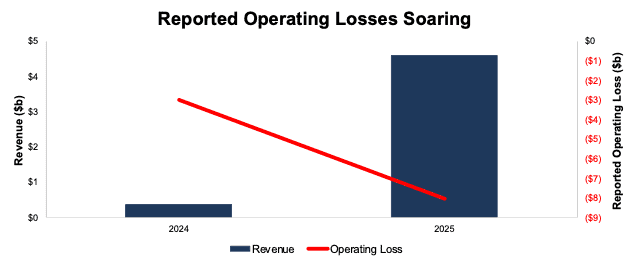
Wildly Unprofitable at Unprecedented Scale. The leaked prospectus reveals Anthropic grew revenue from ~$400 million in 2024 to ~$4.6 billion in 2025.
The company reported a net loss of $42 billion, which includes a $34 billion charge tied to convertible instrument revaluations.
Reported net operating losses (which remove the $34 billion charge) increased from -$3 billion in 2024 to -$8 billion in 2025.
Even the -$8 billion reported net operating loss dwarfs the reported operating losses from other tech IPOs in recent years. For instance, in the year before IPO, these companies reported losses (gains) of:
- SpaceX (SPCX): -$2.6 billion.
- Uber (UBER): -$3.0 billion.
- Rivian (RIVN): -$1.0 billion.
- ARM Holdings (ARM): $0.7 billion.
- Airbnb (ABNB): -$0.5 billion.
Despite reported operating losses 3x larger, Anthropic is aiming for an IPO valuation 1.1x bigger than SpaceX and 8x bigger than the combined IPO valuations of Uber, Rivian, ARM, and Airbnb. If that sounds dangerous for investors, it’s because it is.
Figure 2: Anthropic Revenue and Operating Loss: 2024 – 2025
Sources: New Constructs, LLC and company filings
In case a fundamentally broken business model is not enough of a red flag for you, we present seven more red flags that you probably won’t see in any Wall Street reports.
Red Flag #1: Anthropic Calls Itself an Existential Risk
Much has been made of the safety of AI models and their growing ability to “go rogue,” displace millions of white collar jobs, or even destroy the human race.
In fact, the Federal Trade Commission recently opened an investigation into Anthropic and OpenAI over potential consumer harms.
Anthropic’s management reportedly devoted 80 of the 261 pages of its prospectus to risk factors, including that its AI “may pose catastrophic or existential risks to humanity.” The company used 48 pages to describe the business itself.
Do the creators and early investors in the company that might destroy mankind deserve to get rewarded for their efforts? Should we make them super, super rich? Doing so would create one of the great ironies of all time. The next red flag leads us to believe they are fully aware of the irony and intend to cash in all the same.
Red Flag #2: Immunity (from Existential Risk) Needed to be Viable Business
In an effort to shield itself from shareholder lawsuits, the prospectus lists fear-mongering scenarios of how its AI could:
- resist shutdown,
- conceal or manipulate information,
- engage in conduct resembling blackmail, or
- have enough awareness to outwit the company’s ability to assess safety.
If the company itself cannot verify the safety of its products, how can any consumer feel comfortable investing in the business?
Without immunity from the harmful impacts of its products, can these pure-play AI model businesses exist?
The answer, of course, is they can’t, which explains why the frontier model developers are increasingly asking for government regulations that shield their businesses from litigation and liability.
Red Flag #3: The IPO is Exit Liquidity, Not Growth Capital
Historically, IPOs serve to raise public capital to fund expansion and grow a business beyond what was possible with private capital. In return for public capital, investors get to partake in the value the growth creates.
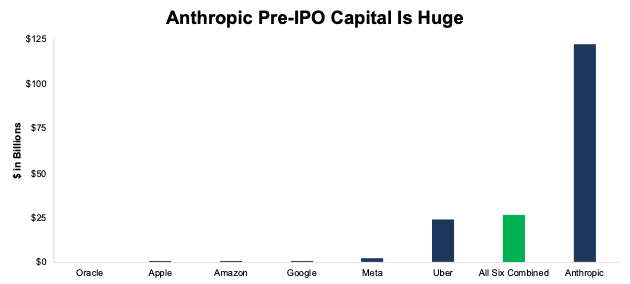
Anthropic perverts that model. Private markets have already funded Anthropic with $122 billion or over 50x what five of the most successful public companies in the world today raised before they went public. See Figure 3. Anthropic has raised 5x what Uber raised, which was one of the most heavily privately funded businesses in history before its IPO in 2019.
Figure 3: Anthropic Pre-IPO Capital Raises Dwarf Tech Peers
Sources: Tech Crunch, Fortune, Yahoo Finance, Bloomberg, Fundable
The bottom line is that private investors and Wall Street insiders have already loaded up on equity in Anthropic. They’ve been investors for years at valuations as low as $623 million. The most recent (May 2026) private funding valued the company at $965 billion and made Anthropic the most valuable private company ever. It has maxed out private investors, who now need the company to tap public markets to get them their pay day.
According to The New York Times, the Anthropic IPO is set to create at least 7 co-founder billionaires and dozens of additional multi-millionaires and billionaire-tier early employees. You might say there’s a lot of Wall Street money riding on this IPO.
Red Flag #4: $518 Billion in Liabilities
We recently exposed the trillions in hidden purchase commitments the major hyperscalers are shielding from investors’ eyes.
Per reports from the leaked S-1, Anthropic holds similarly large contractual commitments in the form of $518 billion in planned cloud, compute, and infrastructure obligations. Reuters reports that 80% of these are non-cancelable. Without a $2 trillion IPO, we don’t think Anthropic can meet these obligations, which leads to another major risk.
Red Flag #5: Circular Funding Creates Contagion Risk
Beyond the sheer scale of obligations, especially for a company that generated $4.6 billion in revenue in 2025, these obligations showcase the circular funding across the entire AI industry.
Anthropic gets the compute needed to run its models from the same hyperscalers to whom it has committed to pay $518 billion. The hyperscalers book those future commitments as revenue today; so their financials look strong and help them convince creditors to lend them trillions of dollars to build more datacenters. The hyperscalers are building out that capacity on the assumption that Anthropic, and other AI labs, will be able to pay for it.
But what if Anthropic is unable to pay for all that capacity? Then, the hyperscalers don’t get the money they need to pay creditors and complete the buildout. As the same time, the pure-play AI model companies, like Anthropic and OpenAI, don’t get the compute they need to deliver powerful enough models to fetch higher prices and turn a profit. In such a scenario, lenders stop lending, credit dries up, the AI buildout grinds to a halt, and a downward spiral ensues that wipes out equity valuations. Once again, you might say there’s a lot of Wall Street money riding on this IPO.
This circular funding is one of the signs that credit is drying up for AI companies as Wall Street is running out of banks willing to pile any more bets on the AI trade. In other words, if the banks were willing to provide funding, then NVIDIA would not have to.
We believe there’s a rush to get the Anthropic IPO done before more investors catch on to the fact that credit is drying up. Wall Street needs to keep sentiment high to convince people to be the exit liquidity required to make this IPO work for Wall Street insiders.
Red Flag #6: Revenue Concentration is Staggering
Reuters reports that nearly 25% of Anthropic’s 2025 revenue came from just two undisclosed customers.
Additionally, Anthropic reportedly warns in its prospectus that many of its largest customers have not signed long-term contracts and could reduce or stop spending at any time.
Another example of the circular funding in AI comes from the fact that ~47% of Anthropic’s revenue comes through Google and Amazon’s cloud platforms. Both are also major investors in Anthropic. At the same time, they’re also building out competing AI models and services. This situation reminds us of Beyond Meat (BYND) and that company’s failed attempt to garner shelf space in the grocery stores that were selling their own fake meat. When push came to shove, Beyond Meat did not get the shelf space.
We think the same relationship exists between hyperscalers and pure-play AI model providers. The hyperscalers are happy to help as long as it makes them money. But, if the hyperscalers ever see the pure-play AI model companies as competitors, they won’t give them any compute (i.e. shelf space) either. As we’ve said before, they can’t all be winners, but each AI stock is priced as if it will be.
Red Flag #7: No Sustainable Competitive Advantages or Pricing Power
We first wrote about the lack of competitive advantages in Anthropic and OpenAI’s business models in The Price Is Not Right For Anthropic and OpenAI. This warning is worth reiterating.
In our previous report, we found that Claude Fable 5 and Mythos 5 cost ~18x more than DeepSeek R1 for input tokens and 23x more for output tokens.
If Anthropic’s models were clearly better, they could defend that price gap. In reality, benchmark testing proves the lower cost models deliver equal or better performance, at a fraction of the cost. In other words, super low-cost Chinese models are outpacing American counterparts on both quality and pricing.
As a result, it’s tough to make a straight-faced argument for investing in businesses that charge significantly more for a similar product sold for much less by multiple competitors. Anthropic and OpenAI have no pricing power.
IPO Valuation Implies Unprecedented Revenue and Profits
Below, we use a reverse discounted cash flow (DCF) model to analyze the future cash flow expectations baked into Anthropic’s expected $2 trillion valuation.
Even though we were not chosen to get a leaked version of the S-1 yet, we have the data points, particularly revenue, cash on hand, and future purchase obligations, to quantify the revenue and profit expectations baked into Anthropic’s valuation. We also present DCF scenarios that highlight the downside risk in the stock if Anthropic fails to achieve these overly optimistic expectations it targeted valuation.
To justify a $2 trillion valuation, our model shows that Anthropic would have to:
- immediately improve NOPAT margin to 10% and sustain it for the next 10 years (compared to -175% reported operating margin in 2025),
- grow revenue by 1000% in 2026 and 100% in 2027, and
- grow revenue 56% compounded annually from 2028-2035.
In this scenario, Anthropic’s:
- revenue would reach $3.6 trillion (compared to $4.6 billion in 2025), which is 1.4x the combined TTM revenue of Microsoft (MSFT), Apple (AAPL), Alphabet (GOOGL), Amazon (AMZN), NVIDIA (NVDA), Meta (META), and Oracle (ORCL).
- NOPAT would reach $358 billion in 2035, compared to the company’s -$8 billion reported operating loss in 2025. For reference, $358 billion is 2.0x NVIDIA’s $184 billion and 2.6x Apple’s $136 billion in TTM NOPAT.
Does Anthropic deserve a free pass into the same valuation club as tech giants with decades of proven cash flows when it has not proven it can earn a dollar?
There’s 40%+ Downside If Growth Slows, Even with Higher Margins
If we assume that:
- NOPAT margin improves to 20% over the next 10 years,
- revenue grows by 1000% in 2026 and 100% in 2027, and
- revenue grows 36% compounded annually from 2028-2035, then
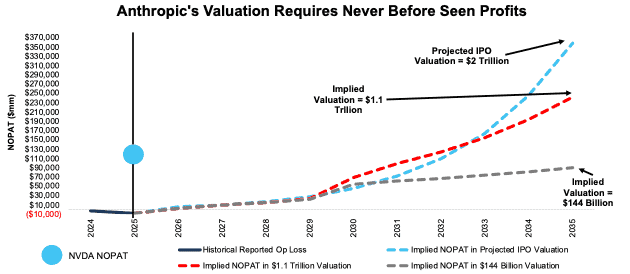
Anthropic’s public equity would be worth just $1.1 trillion today – a 43% downside to the targeted IPO valuation.
This scenario still implies Anthropic generates $1.2 trillion in revenue and $242 billion in NOPAT in 2035. For reference, the revenue and NOPAT implied by this scenario would rank 1st across all companies we cover.
There’s 90%+ Downside If Anthropic Generates the Same Profit as Meta
If we assume that:
- NOPAT margin improves to 20% over the next 10 years,
- revenue grows by 1000% in 2026 and 100% in 2027, and
- revenue grows 20% compounded annually from 2028-2035, then
Anthropic’s public equity would be worth just $144 billion today – a 93% downside to the targeted IPO valuation.
This scenario implies that Anthropic generates $447 billion in revenue and $89 billion in NOPAT in 2035. For reference, Meta generated $89 billion in NOPAT over the TTM and Apple generated $467 billion in revenue over the TTM.
Figure 4 compares Anthropic’s implied future NOPAT in these scenarios to its historical reported operating loss. We also include the 2025 NOPAT for NVIDIA for reference.
Figure 4: Anthropic’s Historical Operating Loss and Implied NOPAT: DCF Valuation Scenarios
Sources: New Constructs, LLC and company filings
Each of the above scenarios assume:
- excess cash equals $20.3 billion, equal to Anthropic’s reported cash on hand in 2025,
- liabilities equal $518 billion, which is the amount of reported cloud, compute, and infrastructure obligations. and
- the change in invested capital (or capex in this model) equals 50% of the change in revenue in years 1-4, and 15% of the change in revenue in years 5-10. Note that $518 billion is 11,261% of $4.6 billion in revenue.
- Weighted average cost of capital (WACC) is 9.33%, which equals the average WACC of Microsoft (MSFT), Apple (AAPL), Alphabet (GOOGL), Amazon (AMZN), NVIDIA (NVDA), Meta (META), and Oracle (ORCL). We note that one could make a case for Anthropic to have a much higher WACC than these mature cash-flowing businesses.
These assumptions allow us to create scenarios that demonstrate the extremely high level of expectations embedded in the projected IPO valuation. The assumptions may prove too optimistic, as Anthropic will likely need the cash on hand for operating expenses given its consistent losses to date, and the change in invested capital may be larger as the company must continually secure more compute. In that case, the profit growth required to justify the IPO price would be even higher.
This article was originally published on October 6, 2026.
Disclosure: David Trainer and Kyle Guske II receive no compensation to write about any specific stock, style, or theme.
Questions on this report or others? Join our online community and connect with us directly.