

This is a free and abridged version of our report The New Constructs Most Wanted List: Worst AI Earnings Manipulators. The full report is available here.
We’ve documented, in deep detail, the many ways AI companies are hiding trillions in off-the-books debt to support their AI spending. We were the first to warn investors about Residual Value Guarantees. Today, we’re here to warn of a new risk that these companies and their Wall Street bankers hope investors never notice.
$1.4 Trillion in Hidden Earnings Expectations
This new risk is major earnings manipulation by AI companies: the unspoken incremental earnings they must earn on the $3.6 trillion in off-the-books debt to prevent their stock prices from getting crushed. No one else is raising this red flag, as far as we can tell, perhaps because alerting investors would cause stock prices of AI companies to plummet.
Specifically, the issue is that the top 25 companies in the S&P 500 (by market cap) must generate $1.4 trillion in new profit on top of what they already earn to justify their ~$4 trillion in hidden debt. We call this required return the hidden earnings expectations (see details in Appendix), and it’s a risk we think the market is missing.
Another way to think about these incremental earnings is as the incremental net operating profit after tax (NOPAT) required for the AI companies to create economic value from the off-the-books debt that is comparable to what they create from their on-the-books assets. Otherwise, the AI investments are dilutive to economic returns on capital.
How Companies Hide Trillions in Debt & Obligations
First, let’s take a second to remind readers how companies hide debt off the books so they can manipulate their earnings and operating cash flow with operating leases, residual value guarantees, and purchase commitments.
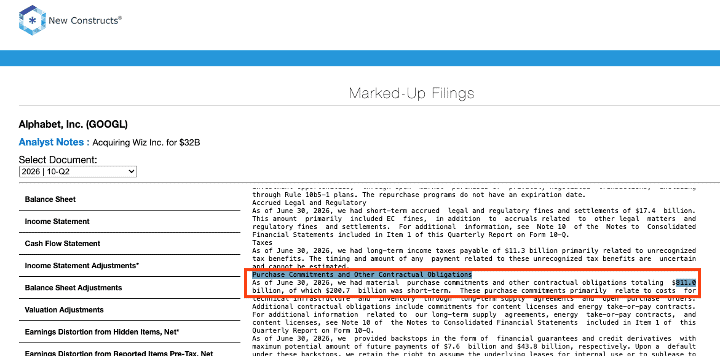
Like other accounting loopholes, companies disclose these off-balance sheet commitments in the footnotes under multiple names, such as purchase commitments, unconditional purchase obligations, or contractual commitments. Each achieves the same goal: keeping future non-cancelable commitments off the balance sheet.
Figure 1: Example of Purchase Commitment in Alphabet’s 2Q26 10-Q
Sources: New Constructs, LLC and company filings
Hidden Obligations Are Huge: 3 Times as Large as On-the-Books Debt
Across our coverage universe, we’ve identified over $3.3 trillion (and counting) in disclosed purchase commitments alone. The five largest hyperscalers disclosed $1.5 trillion in purchase commitments in their latest filings.
When we account for all hidden debt, which includes the present value of purchase commitments, not-yet-commenced leases, and operating leases, the liabilities are even larger.
AI Companies Are the Biggest Offenders by Far
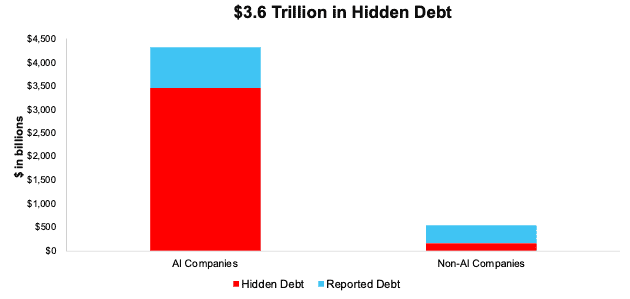
The 25 largest (by market cap) companies in the S&P 500 hold $4.9 trillion in total debt, which consists of ~$3.6 trillion in hidden debt and ~$1.2 trillion in reported debt.
AI companies within this group (13 companies) hold $3.5 trillion in hidden debt (95% of ~$3.6 trillion hidden debt) and $851 billion in reported debt (69% of ~$1.2 trillion in reported debt).
Figure 2: Hidden and Reported Debt Across the 25 Largest S&P 500 Companies: TTM
Sources: New Constructs, LLC and company filings
* AI Companies in this analysis include companies in the top 25 (by market cap) of the S&P 500 that we consider AI or AI related companies. Specific tickers available in full report only.
Growing Like a Weed
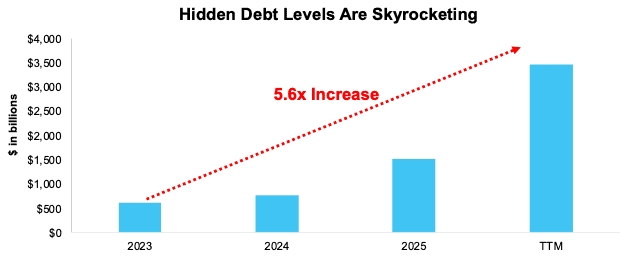
Figure 3 illustrates the speed at which the companies are piling on hidden debt. Of the AI companies in the top 25 (by market cap) of the S&P 500, hidden debt has increased from $623 billion in 2023 to $3.5 trillion over the TTM, or a 5.6x increase.
We think companies are pouring trillions into AI so they can cash in on the AI mania in much the same way Wall Street and big corporations cashed in on the internet bubble back in 1999.
Figure 3: Hidden Debt: AI Companies in Top 25 S&P 500: 2023 – TTM
Sources: New Constructs, LLC and company filings
*AI Companies in this analysis include companies in the top 25 (by market cap) of the S&P 500 companies that we consider AI or AI related companies. Specific tickers available in full report only.
Exposing the Earnings Manipulation Trick Due to Hidden Debt
Hidden debt doesn’t just increase liabilities. It also raises earnings expectations.
In theory, the purpose of the stock market is to assign value to companies based on the economic value the companies generate. Economic value, aka economic earnings, equals invested capital times [return on invested capital (ROIC) minus the weighted-average cost of capital (WACC)].
To keep investors happy, companies need to earn the same (or higher) return (e.g. ROIC) on the off-balance sheet capital as they earn on the on-balance sheet capital. Hidden capital needs to generate the same or better economic value or ROIC, or else why deploy it? We call this required return on hidden capital the “hidden earnings expectations.”
We’re not here to make a claim that the huge AI spend will or will not pay off. That’s not the question investors need to answer. But, they do need to know the earnings manipulation trick being played on them to avoid owning stocks that could implode.
This report exposes that risk by quantifying the level of incremental future earnings from off-balance-sheet AI debt required to keep stock prices from cratering. As the hidden debt keeps growing, so does the required earnings growth. The longer profits lag the required level, the more the market is paying for returns that haven’t materialized. And, the risk that certain stocks will implode grows.
The Math Is Simple
Here’s how we quantify hidden earnings expectations for AI companies.
- Measure the ROIC before the companies added hidden debt, which is 39% on average.
- Multiply that ROIC by the amount of hidden debt, which is $3.6 trillion in total.
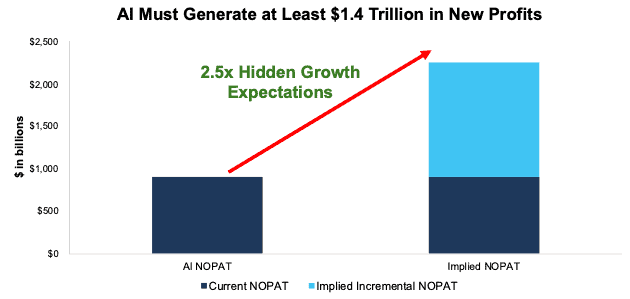
- The result is $1.4 trillion in incremental net-operating profit after-tax (NOPAT).
Combined with the NOPAT they’re already generating, the new NOPAT of the AI companies must be 2.5x higher than current levels to earn an adequate ROIC on their hidden debt. See Figure 4.
If the AI companies earn a lower ROIC on the hidden debt, then their AI investments are less profitable than their existing business. In which case, the stock market should reassess their value lower to align with a less profitable business model.
You won’t find these hidden earnings expectations anywhere else because no one else has (1) accurate ROIC data or (2) the complete hidden debt obligations data.
Figure 4: Implied Incremental NOPAT to Generate Adequate ROIC on Hidden Debt
Sources: New Constructs, LLC and company filings
*AI Companies in this analysis include companies in the top 25 (by market cap) of the S&P 500 companies that we consider AI or AI related companies. Specific tickers available in full report only.
The Most Wanted List: Worst Earnings Manipulators
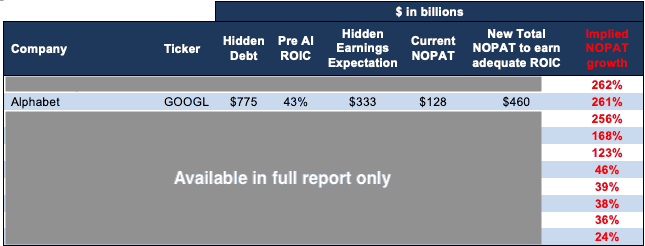
We’re here to help investors bring these companies to justice. Figure 5 lists the top 10 companies from S&P 500 with the worst earnings manipulation, or largest hidden earnings expectations. The full list is only available in the full report here.
We consider these companies the worst earnings manipulators because, by keeping trillions in debt off the balance sheet, they’re also hiding from investors the profit growth required to keep Mr. Market from rerating their stocks.
Alphabet (GOOGL), which is the second company on the list, has $333 billion in hidden earnings expectations which are driven heavily by the sheer quantity of its hidden debt, which sits at $775 billion.
Figure 5: 10 Most Wanted Earnings Manipulators: Time for Justice
Sources: New Constructs, LLC and company filings. Note: these companies come from the top 25 (by market cap) in the S&P 500.
The takeaway for investors: don’t just track how much debt, on and off the books, these companies are taking on. Track how much their earnings need to grow to keep their stock prices from imploding.
We think it’s fair to treat any AI company whose profit growth is falling behind its hidden earnings expectations as a stock that is getting more expensive and more risky, no matter what traditional valuation metrics may say.
This article was originally published on September 23, 2026.
Disclosure: David Trainer and Kyle Guske II receive no compensation to write about any specific stock, style, or theme.
Questions on this report or others? Join our online community and connect with us directly.
Appendix: Here’s the Math
Hidden earnings expectations quantify how much incremental profit a company must generate on its hidden debt to earn a specific ROIC. Because this debt is hidden from balance sheets, most investors don’t know to expect a company to earn a return on it, which is why we consider the earnings expectations “hidden”.
We calculate hidden earnings expectations accordingly:
Hidden Debt X ROIC = Hidden Earnings Expectation
The hidden earnings expectation measures how much incremental profit a company must generate on its hidden debt to earn a specific ROIC on the hidden debt.
For the analysis throughout this report, we assume the ROIC each company must earn equals it’s “Pre-AI” ROIC, or the ROIC the company earned before AI spending skyrocketed. We think these assumptions accurately hold companies accountable for their AI spend by expecting them to generate a return that is at least on par with the ROIC of the business before the heavy investment took place.