
With an ever-growing list of similar-sounding mutual funds to choose from, finding the best is an increasingly difficult task. How can investors change the game to shift the odds in their favor?
Don’t Trust Mutual Fund Labels
There are at least 1,293 different Large Cap Growth mutual funds and at least 5,838 mutual funds across ten styles. Do investors need 583+ choices on average per style? How different can the mutual funds be?
Those 1,293 Large Cap Growth mutual funds are very different. With anywhere from 14 to 1,934 holdings, many of these Large Cap Growth mutual funds have drastically different portfolios with differing risk profiles and performance outlooks.
The same is true for the mutual funds in any other style, as each offers a very different mix of good and bad stocks. Large Cap Value ranks first for stock selection. Small Cap Blend ranks last. Details on the Best & Worst mutual funds in each style are here.
Avoiding Analysis Paralysis
We think the large number of style mutual funds hurts investors more than it helps. Manually conducting a deep analysis for every fund is simply not a realistic option, exposing investors to insufficient analysis and missing profitable opportunities. Analyzing mutual funds, with the proper diligence[1], is far more difficult than analyzing stocks because it means analyzing all the stocks within each mutual fund. As stated above, there can be as many as 1,934 stocks or more for one mutual fund.
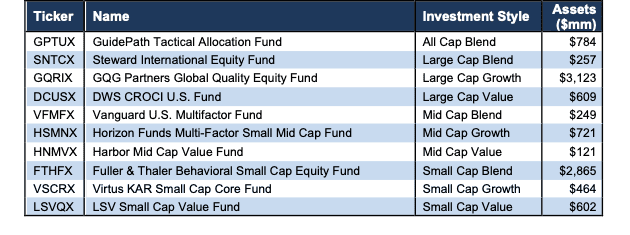
Anyone focused on fulfilling the fiduciary duty of care recognizes that analyzing the holdings[2] of a mutual fund is critical to finding the best mutual fund. More reliable & proprietary fundamental data, proven in The Journal of Financial Economics, drives our research and analysis of fund holdings and provides investors with a new source of alpha. Figure 1 shows our top rated mutual fund for each style.
Figure 1: The Best Mutual Fund in Each Style
* Best mutual funds exclude funds with TNAs less than $100 million for inadequate liquidity
Sources: New Constructs, LLC and company filings
Amongst the mutual funds in Figure 1, DWS CROCI U.S. Fund (DCUSX) ranks first overall, GQG Partners Global Quality Equity Fund (GQRIX) ranks second, and Fuller & Thaler Behavioral Small Cap Equity Fund (FTHFX) ranks third. Virtus KAR Small Cap Core Fund (VSCRX) ranks last.
How to Avoid “The Danger Within”
Why do you need to know the holdings of mutual funds before you buy?
You need to be sure you do not buy a fund that might blow up. Buying a fund without analyzing its holdings is like buying a stock without analyzing its business and finances. No matter how cheap, if it holds bad stocks, the mutual fund’s performance will be bad. Don’t just take my word for it, see what Barron’s says on this matter.
PERFORMANCE OF FUND’S HOLDINGS – FEES = PERFORMANCE OF FUND
Analyzing each holding within funds is no small task. Our Robo-Analyst technology enables us to perform this diligence with scale and provide the research needed to fulfill the fiduciary duty of care. More of the biggest names in the financial industry (see At BlackRock, Machines Are Rising Over Managers to Pick Stocks) are now embracing technology to leverage machines in the investment research process. Technology may be the only solution to the dual mandate for research: cut costs and fulfill the fiduciary duty of care. Investors, clients, advisors and analysts deserve the latest in technology to get the diligence required to make prudent investment decisions.
If Only Investors Could Find Funds Rated by Their Holdings
Our mutual fund ratings leverage our stock coverage. We rate mutual funds based on the aggregated ratings of the stocks each mutual fund holds.
DWS CROCI U.S. Fund (DCUSX) is not only the top-rated Large Cap Value mutual fund but is also one of the top-rated style mutual funds out of the 5,838 style mutual funds that we cover.
The worst mutual fund in Figure 1 is Virtus KAR Small Cap Core Fund (VSCRX, which still gets a Very Attractive rating. One would think mutual fund providers could do better for this style.
This article was originally published on April 28, 2026.
Disclosure: David Trainer and Kyle Guske II receive no compensation to write about any specific stock, sector or theme.
Questions on this report or others? Join our online community and connect with us directly.
[1] Three independent studies from respected institutions prove the superiority of our data, models, and ratings. Learn more here.
[2] Harvard Business School features the powerful impact of our research automation technology in the case New Constructs: Disrupting Fundamental Analysis with Robo-Analysts.