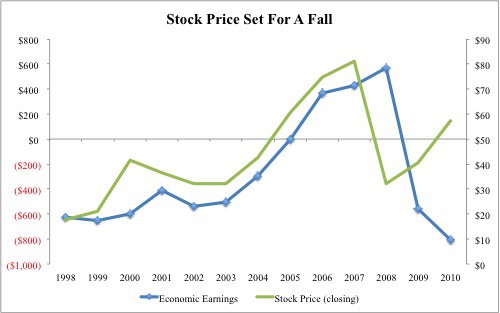
Do not be fooled by the recent stock market run-up. Think of it as a set-up for a fall. Investors need to protect their portfolios from the eventual economic decline that will stem from the euro debacle.
Here is the explanation behind why I suggested investors "brace" their portfolio and go net short in my "Don’t be fooled: Get short now" column on MarketWatch.com. In addition, I provide free reports on the stocks and funds I suggest shorting.
VMW’s valuation has its head in the clouds.
This stock is a great short in most any scenario and is especially attractive in the event of a global economic slowdown led by a recession in Europe.
High dividend yields are NOT enough to warrant investing in the utilities sector.
Too many investors put their hard-earned money in utility stocks with the assumption that relatively high-yielding dividends from stable business make a good investment.
The real question that investors in any equity security must ask is: does my expected return from a stock justify the risk of investing in it?
Similar to my prior interviews on SBUX, I found it easy to make the bear case for a stock that is as expensive as Starbucks (SBUX). As my regular readers know, when I say "expensive", I back that up with details such as: to justify its $40 stock price (closing price from prior day), SBUX had to grow profits at 10% compounded annually for more than 25 years.
In addition to my stock-brawl interview on Thursday (9/29/11), I have commented to the media on Starbucks (SBUX) many times. Below is a list (with links) to my past opinions/comments on SBUX.
It is only a matter of time before oil and gas stocks stop moving with the price of oil and start reflecting their underlying economics.
When this happens, Baker Hughes (BHI – “very dangerous” rating) will be among the stocks that fall the hardest.
Accounting rules provide the biggest loopholes to asset intensive businesses. And the off-balance sheet operating lease loophole is one of the biggest.
By exploiting this loophole, Starwood is able to omit nearly $1 billion in debt from its balance sheet in 2010, $200 million (20% of the total) was added in 2010.
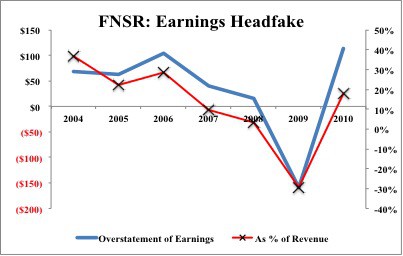
The worst is not over for Finisar Corporation (FNSR)’s stock. Despite dropping over 50% since March, the stock remains on our most dangerous stocks list, where it has been since October 2010.
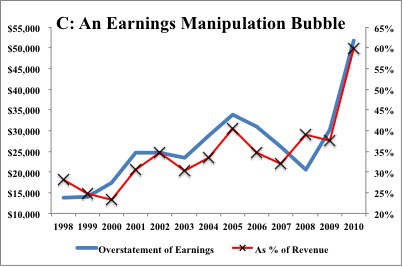
Citigroup is running out of accounting tricks and the stock will continue its slide as investors recognize the company is not as profitable as it wants investors to believe. Our analysis of the financial footnotes of more than 50,000 annual reports means we know more about which companies have the naughtiest and the nicest accounting. And Citigroup is definitely on the naughty list.
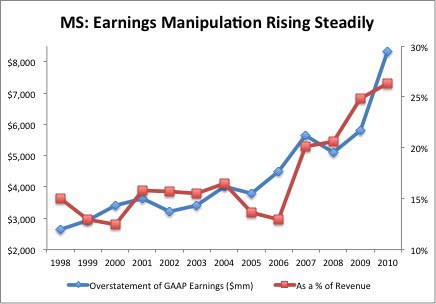
When Morgan Stanley (MS) started in 1935, there were around fifteen employees. For 2010, the company reported 62,542 employees. Bigger is not always better. And for big, publicly-traded companies, big tends to be worse especially when it comes to financial reporting.
Caterpillar Inc. (CAT) gets our Dangerous Rating. This means CAT’s quality-of-earnings are not attractive and the stock’s valuation is very expensive. For example, the valuation of the current stock price ($112.16) implies the company will grow its profits at 16% compounded annually for 20 years. The takeaway: there are better stocks to choose from. See details in our free report.
Is VHC the next Google? The market’s current valuation seems to suggest it is that and much more.
Very few times in the last 15 years have I found a stock as expensive as VHC. The only comparable situation that comes to mind is Google (GOOG) at its IPO.
2010 earnings for the retail apparel sector have been quite strong, especially compared to 2009. However, looking behind the window dressing of reported earnings, we find that not all earnings are made the same. Zumiez Inc. (ZUMZ), retailer of cool, new action apparel turned to an old accounting trick to boost its 2010 earnings by 13%
What I bet very few people, outside the company itself, know is that EK’s pension liabilities could torpedo the company into bankruptcy and send the stock to significantly lower levels. In the company’s recently published 10K, we found that EK’s pension obligations are underfunded by $2.6 billion, about 3 times the company’s market value.
Caterpillar Inc. (CAT) gets our Dangerous Rating. This means CAT's quality-of-earnings are not attractive and the stock's valuation it very expensive.
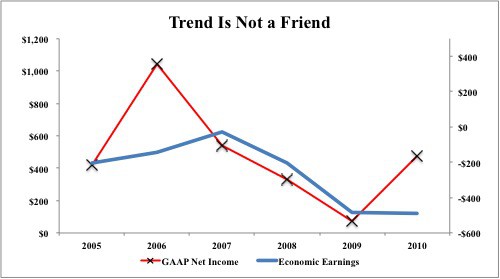
Principal Financial Group, Inc. (PFG) reported accounting earnings in 2010 that are misleading compared to the true economic earnings of the business. PFG’s 2010 reported earnings are artificially boosted by a reduced loan loss expense, which is funded by a draw down of the company’s loss reserves.